What the NFC Wild Card games could have looked like

As the NFL Playoffs start this weekend spare a thought for Arizona Cardinals fans. Their 8-8 season is hardly earth shattering but they were the seventh best team in the NFC but failed to capture one of the seven playoff places.

The reason is that the playoffs are made up of the four division winners plus three wild-cards featuring the next best teams. Washington were division winners with a losing season (7-9) but the divisional title is more valuable than the overall win-loss record.

Another benefit of being division winners is that Washington are seeded fourth (as the lowest divisional winner) rather than seventh as the worst team in the playoffs. This means facing a slightly easier playoff rival and possibly avoiding Green Bay in the next round.

So what would the playoffs look like if it was just the top seven teams in the conference who made it through, with no divisional winner seeding?

The diagram below shows the Wildcard games happening this weekend compared to an imaginary set of games based on divisional placings with no exception for divisional winner.  Chicago and Los Angeles might be happy to get an easier game (based on seedings alone), while Tampa Bay fans may be disappointed to have lost the chance to play Washington.

But Washington’s stroke of luck is an unusual event, only four teams have ever made the playoffs with a losing record, and the last was Seattle in 2015. Keeping privileges for division winners ensures strong division rivalries which is what fans thrive on – even if you can’t make the playoffs you can at least save a season by beating your fiercest rivals.

So while it is fun imaging different playoffs scenarios, there is a trade off between postseason fairness and the passion of all fans across the whole season. This year’s playoffs are probably unfair for some, but it doesn’t make the overall system broken.

Whatever happens from here Washington are record breakers. They are the first team in the Super Bowl era to qualify for the postseason after going 2-7 in the first nine games. Of course, this this is unlikely to be remembered as some miracle comeback ready for the movies, but rather how Philadelphia rolled over in the last game of the season to protect their draft pick position.  

NOTE: credit for the image at the top goes to the NFL for creating such cool graphics.

Lessons from a year of writing about sport

Looking back at a year of sport blogging there was still plenty to discover in this strangest of seasons.

I can’t remember who wrote it, but I remember reading that a good way to get yourself through lockdown was to find something that interested you and dedicate some time to that. So this year I decided to ramp up the sport blog I started in 2019.

In 2020 I managed to write over 11,000 words (some of them good, some of them not so good) and produce a series of different graphics (some of them good, some of them not so good). But I enjoyed it, I experimented, and I learned about sport and my own abilities.

To finish the year, I’ve collected the most interesting things I’ve learned in five areas: my own “Big Three sports” that I tend to write about most (horse racing, football and cycling); supporters; and the role of technology.

Going forward I plan to continue writing and expand the number of sports and topics I write about. Hopefully in 2021 there will be plenty to talk about on the pitch, track and road as that will mean there is plenty of sport actually happening – I can’t wait!

Here’s what I learned this year…

Horse racing – learning from the trends can show you two horses to avoid for next year

Football – money, money, money

Cycling – the future is looking good

Supporters need sport, and sport needs supporters

The rise of technology and the future of sport

Here’s looking forward to a better 2021 and plenty of more stories….

“Horses for courses” has a measure of truth

The stats show it doesn’t pay to follow the winner of the King George Chase on Boxing Day all the way to Cheltenham.

The expression “horses for courses” is listed in the Cambridge Dictionary as a phrase ‘to say that it is important to choose suitable people for particular activities because everyone has different skills.’

The phrase is just one of many horse racing expressions that have made their way into everyday life. It is based on the idea that some horses are better suited to running at some racetracks, for example, the layout of the course suits their style or the horse might have a positive or negative memory associated with a previous visit.

This is particularly true of racecourses in Europe that can be so different to each other compared to North American standardised ovals.

This idea will inevitably raise its head over Christmas when thoughts turn to whether the winner of the King George at Kempton on Boxing Day, probably the second most prestigious race for staying chasers, can go on to win the Gold Cup at Cheltenham.

There are a number of arguments against such a double. For example Kempton is a right-handed track while Cheltenham left-handed, and Cheltenham places a greater emphasis on stamina than the flatter Kempton which is more of a speed track.

What do the stats say?

  • Looking back at results from 1982, only six horse in the last 38 years have won at Kempton and then followed up the next year at Cheltenham – a 16% success rate.
  • Looked at a different way, seven King George winners since 1982 are also Gold Cup winners – 18% of all winners.
  • Long Run was the last horse to complete the double in 2010.

Overall you can see that there is probably a bit of truth in the “horses for courses” expression, especially where Kempton and Cheltenham are concerned. Of course, it is one thing to identify a trend, but it another to explain it.

I suspect that the left-handed, stamina sapping Cheltenham layout has a lot to do with it, but there are also factors such as the intense competition of winning the biggest race in the calendar, and the sheer randomness within any race that need to be taken into account.

The main take-away from all of this is that whoever wins the King George this Boxing Day, I wouldn’t be running to the bookies to back him for Cheltenham.

If your goal goes to VAR, expect the worst

If your team scores a goal in the Premier League but then it goes to VAR, don’t get your hopes up. So far this season 80% of VAR goals decisions have resulted in a goal being disallowed.

Ten teams have had goals disallowed, while only four have had them confirmed, and only one team (Aston Villa) have been on the end of both decisions. The table below shows the ‘balance’ for each team: the number of goals they have had confirmed by VAR minus the number of goals they have had disallowed. Liverpool fans will feel they have the most to complain about since they have a balance of -5 goals (five disallowed and none confirmed), well ahead of Aston Villa and Man Utd.

But spare a thought for Burnley, they have only scored four goals all season with one disallowed goal. This means that 20% of the time they score a goal it is disallowed. Free scoring clubs like Liverpool can probably get away with a few grumbles about VAR and still take the points, but for clubs struggling to find the back of the net this can seem much worse.

Of the other clubs, fans of Arsenal, Chelsea and Brighton should consider themselves the lucky ones, having had a goal confirmed by VAR. Brighton in particular probably love VAR as it has disallowed three goals against them, the most of any team.

Referees are right most of the time

Another question to ask from the data, is what does it tell us about referees? If you imagine that all goals are allowed to stand and then checked retrospectively, there would have been 314 goals scored so far this season and 17 disallowed. This gives an ‘error rate’ among referees of 5.8%.

Considering how the faster pace of the game makes it more difficult to referee (players have always been dishonest so the current gamesmanship is nothing new), then the fact that referees get goals right 94% of the time is a good result.

They are only human and nine out of ten is not a bad record for anyone.

Source: This data came from Opta, through a BBC Sport story https://www.bbc.co.uk/sport/football/55160134

The future of cycling is young (and there are lots of them)

The last two years have seen new trends emerging among the winners of cycling’s Grand Tours. Not only is a much younger generation of riders emerging, but a larger pool of talent suggests a more unpredictable and exciting future for fans.

Last year I wrote a blog about how cycling’s Grand Tour winners tend to come in generational waves. When looking at the average age of winners each year you could see the moment when a new generation took over – the average age dropped, only to gradually rise as these riders took control of the races for years to come.


The 2019 data suggested we were at the start of a new wave, with young riders like Egan Bernal (22) and Richard Carapaz (26) winning the Tour de France and Giro D’Italia respectively. Including Primo Roglic, the average age for Grand Tour winners was 26 years old, a dramatic change from the average since 1989 of 29.6.


As the dust settles on another season and we add more data, two differences have emerged from the usual trends.

  • The average age of Grand Tour winners has remained at 26 rather than start to rise, and since everyone got a year older in 2020, this is almost like going down again.
  • Another new group of young winners emerged in two out of three races this year.

The table below shows the average age of all three Grand Tour winners in each year since 1989. Like an Alpine Stage profile, it shows the peaks and troughs of different generations, but also the dramatic decrease last year, which plateaued in 2020.

The average age of grand tour winners 1989-2020

Explaining this changing trend is not easy as there are likely to be multiple reasons, but most of the credible explanations will hopefully be great news for cycling fans.

Perhaps the most obvious reason is that there is a larger pool of talented young cyclists coming through. That would explain why the average age remained the same rather than start to rise as a new generation comes to dominate. It is likely that this new generation is still trying to establish its own pecking order.

Secondly, throughout histroy these young talented riders may have always existed, but it is only now that they are being given the chance. So perhaps a new generation of Director Sportifs is willing to place more trust in young riders.

Finally, and perhaps more speculatively, it may be that we are seeing the end of the old unwritten rules of cycling that protect the established riders and expect younger riders to ‘serve their time’ in support of others.

As with so many other walks of life, cycling is seeing the rise of disruptors who will make races more exciting and unpredictable in the future. Something that would be good for the sport overall.

What does the future hold for the most expensive yearling bought at auction?

The news that a horse has become “the most expensive yearling sold at auction this year” always catches attention, and this month was no exception as Coolmore paid £3.5m at Tattersalls Yearling Sales Book One at Newmarket.

However, looking at the results of the last ten years does not suggest we should be expecting too much, indeed it would make you think that the “most expensive” label is more like asking the jockey to carry an extra stone of weight when the horse runs.

Looking back over the last ten years, the figures show that if you had bought the most expensive yearling each year you would have spent close to £30m. In return would have won just under £450,000 in prize money. Not a great return or a very exciting decade as only three of your ten horses actually won a race, and only one (Glorious Journey) won a Group race – which is what it’s all about at this level.

Figure 1: Owning the most expensive yearlings at auction for the last ten years

The tale below shows the details including how much the yearling cost at auction, how much prizemoney it won, and what type of races.

Table 1: Most expensive yearlings at auction and their future performance

(f)=filly, data for European bloodstock market

Of course, prize money isn’t everything, and possible stud careers would also have been in the mind of the bidders. But, while these new purchases might have regal blood coursing through their veins, if they haven’t proved it on the racecourse they are unlikely to get much of a chance at stud.  

This might explain why half of the most expensive horses each year were fillies. At least with these you have a fall back option as female blood lines are just as important as performance. This might also explain why several of these fillies never saw a racecourse.

Kissing frogs

The data shows that with horses you have to kiss a lot of expensive frogs to find a prince, and being top of the crop in the ring is no guarantee of success on the racecourse. Take Darain as an example, he cost £3.5m and disappointed with only two small race wins amounting to nine thousand pounds. Meanwhile Mogul, who cost £3.4m in the same year, has gone on to win a Gordon Stakes at Goodwood and the Grand Prix de Paris (earning £328,000 along the way).

Success at the top-end of horse racing is only for those who can afford to write-off a few million in the hope that their next big purchase will produce a different outcome. Meanwhile one final thought for punters is that horses with the “most expensive” price tag are worth opposing when they reach the racecourse.

What would one billion euros get you in the current football market?

This week has seen an inordinate amount of articles and analysis about where Lionel Messi will be playing next year, with more interest on his release clause value than the fact that the contract was pretty clear that he wasn’t going anywhere.

This did lead me to wonder, if this is the season for outlandish speculation then how much would it cost to assemble a Superteam of the best players across Europe?

The first question was who would make it into the team? To avoid any bias I needed an objective scouting process, so I turned to the Ballon D’or Power Rankings for 2020. Like a playground kick-about I selected players for each position with highest ranked player fitting into each position.

This led to the immediate problem of being spoilt for choice upfront, and in the end it was Neymar who lost out, being ranked behind Lewandowski, Ronaldo and Messi. I also ended up with quite an attacking midfield, of Kevin DeBryune, Kylian Mbappe and Serge Gnabry.

The other problem was that as usual it is the strikers who get all the attention and I couldn’t fill my back line as there were not enough defenders in the Power Rankings (and I’m going to need some good defenders based on my attack minded midfield). To the keep the objectivity going I turned to player rankings from the CIES Football Observatory and filled the final few spots on my team from the highest ranked player for that position.

The CIES rankings are based on OptaPro data and place a lot of emphasis on recent form of the player and team, which is my only explanation for how Harry Maguire made it into my Super team!

Finally, for goalkeepers I used the Four Four Two ratings, which put Jan Oblak ahead of Liverpool’s Alisson.

So how much will it cost me?

Now that I had my prospects, I needed to value them. There are a number of websites that do this but I went with CIES since the web browser was already open. Using their valuation I could work out that the team would cost 1.05 billion euros to assemble.

Of course, this has been the week of the release clause, so I had to check which players had a release clause in their contract, and how much was it. When this is added to the equation (five players have a release clause) the acquisition cost rose to 1.85 billion euros.

So my Superteam shown below will cost around two billion euros to bring together, and that’s before I start paying them. I don’t think I’ll be able to get this through Financial Fair Play!

Players valuations (with any release clause in brackets)

Modern Premier League sponsorship and the two G’s – Gambling and Globalisation

Comparing Premier League shirt sponsors at the start of this season with those twenty years ago gives an insight into how the league has expanded into new territories, both geographic and industry type.

The most commonly discussed change is probably the emergence of gambling sponsors, with five teams now advertising online. However, football sponsorship has always had a close connection with one vice or another, and in the last twenty years we have just moved from beer and crisps to gambling.

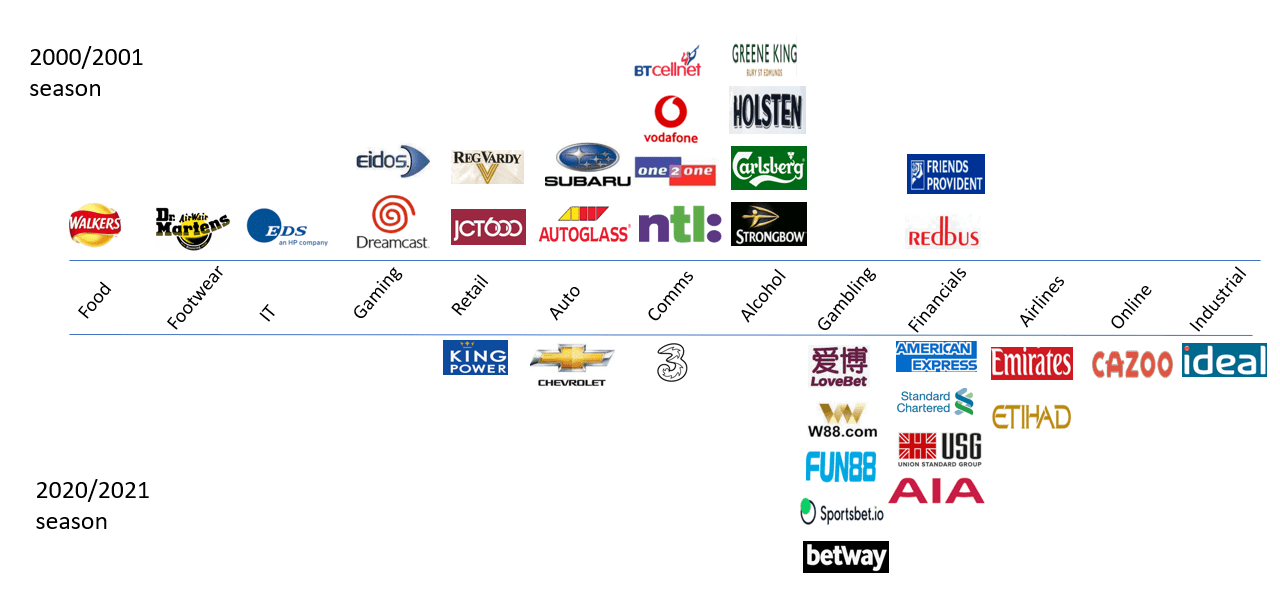
As you can see from the graphic below, at the start of the 2000/2001 season there were four drinks companies sponsoring teams and no gambling (understandable since it was illegal at the time), whereas now there are five gambling and no drinks companies.

Shirt sponsors in 2000/2001 season (top) and 2020/21 (below)

However, gambling to alcohol is not the only change from the past twenty years.

  • Telcoms company 3 is the only sponsor from that sector this year compared to four at the turn of the century.
  • Gaming companies are no longer involved in shirt sponsorship, perhaps because they have moved to sponsoring content during televised games and focussing on their own eSports leagues and teams.
  • Airlines are modern day sponsors who were not around in 2000/2001, although many would argue that this final group is really sovereign states using football as ‘soft power’ in international relations.

Depending on your view the world, you might see these changes as part of a conspiracy to corrupt supporters through vice and political manipulation – failing to pass the FA’s own regulations prohibiting ‘ethically or morally offensive’ and ‘political’ messages. For example, worries about sponsorship have led to calls for increased regulation, with the Labour party looking to ban gambling advertising.

The globalisation of sponsorship

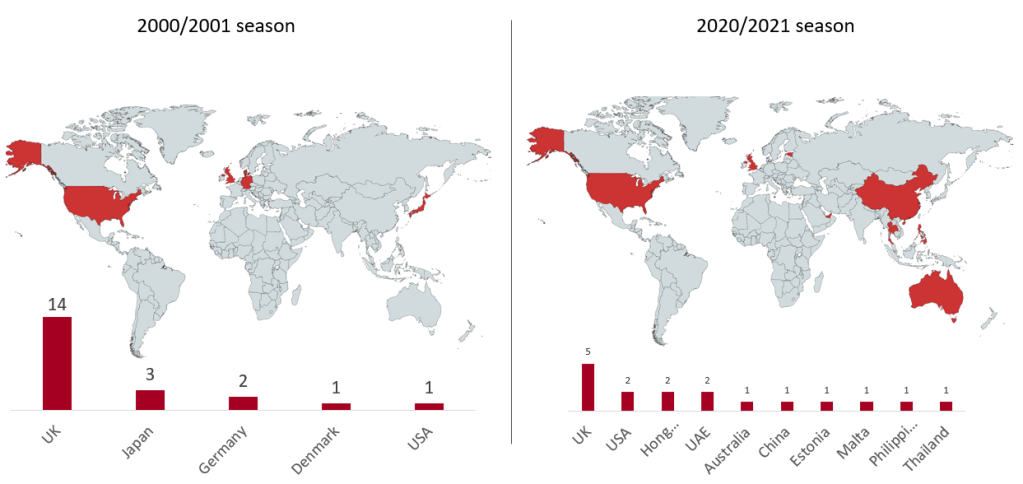
However, the desire to regulate shirt sponsorship throws up an interesting question about how much of this advertising is aimed at UK residents? Looking at changes in the location of sponsors in the last twenty years shows a dramatic shift outside the UK towards the Middle East and Asia. In 2000/2001, 14 sponsors were UK based, but now that number is down to just five.

Location of companies sponsoring Premier League clubs

In part that is due to the global nature of business, but more so it is driven by the increasing popularity of the Premier League in new markets, with many sponsors using Premier League clubs to promote themselves in other countries. This explains why the lucky Chinese number 8 often appears at the front of shirts as well as the back.

As a result, removing gambling from Premier League shirt sponsorship is unlikely to make much of an impact on the UK’s gambling problem as most of the companies are looking to the Asian market. This is the contradiction of the Premier League. While it is made up of teams still very much rooted in their communities, technology and television has made is equally relevant to people thousands of miles away.

Perhaps the time has come for the FA to review it’s regulations on sponsorship to take a greater account of this global phenomenon, or perhaps it is a time for greater international agreement on what can and cannot be put on a football shirt.

What computer generated crowds miss

Last month the Irish Cup Final between Ballymena and Glentoran received an unusual amount of national attention, as it became the first game to be played in the UK with a crowd since the COVID-19 shutdown.

While there were only 500 supporters allowed (a big crowd for Irish League football some comedians would suggest) what was noticeable was how much more atmosphere 500 people could create, compared to the computer generated white noise that accompanies current televised sport.

Perhaps the most interesting aspect is how the crowd reaction to regular events can set the tone for the next phase of the game. For example, a crunching tackle can raise a cheer that expands into a roar of support for the team to pick it up – usually having the required impact on the motivation of the players.

This made me think about all those little things that happen in a football match that would never be picked up by the computer generated crowd. While pretend noise is better than nothing, watching the Irish Cup Final showed that a match with 500 supporters still has a much better atmosphere than anything artificially created.

Basically, supporters have a real connection with action on the pitch, and it is their passion and unique sense of humour, that makes the game what it is.

With that in mind I’ve put together below some of those events and stories that the computer just doesn’t get.

Which Premier League clubs got what they paid for?

It is a general rule of thumb in professional sport that the teams that pay the biggest salaries are the most successful. Looking at the final Premier League standings this year supports that trend, with the top four in the table also having the biggest payrolls*. However within the top four, some teams got more for their pounds/dollars/rubbles than others.

Liverpool were undoubtably the most efficient, finishing 33 points above Chelsea despite having a similar payroll.  Meanwhile Manchester United underachieved (relatively speaking) when you consider they scraped into third with every point costing them £2m compared to £1.1m for Liverpool.

Across the whole league a points per payroll calculation is a good way to look at which clubs outperformed their salary budget and which underachieved. In the diagram below you can see how five teams performed at around the league average (Brighton, Newcastle, Spurs, Chelsea and Manchester City). Big spending City would have won had it not been for Liverpool getting such value from their salaries.

Those teams above the blue line overachieved and generally their fans will be happy with the season. While Leicester and Sheffield Utd may feel disappointed at falling away towards the end, they will eventually come round to seeing it was a good season. Sheffield Utd have probably had the best season, challenging for European places on a budget one-tenth the size of Manchester Utd.

These fans will definitely be feeling a lot better than those of teams below the line. These are the teams whose fans are asking why they are paying these players such large salaries. Arsenal, Everton and Crystal Palace in particular fall into this group – they paid £1.6m to £1.7m for every point of their mid-table obscurity.

Meanwhile at the bottom there must be a special mention for Aston Villa. While they also performed worse than would be expected, with the second smallest salary budget in the league they somehow managed to pull of the great escape.

 *Payroll data from spotrac.com

Design a site like this with WordPress.com
Get started