
Late in December the NHL decided to withdraw from sending players to the 2022 Winter Olympics. It was a decision that disappointed those wanting to promote the sport in Asia, as well as many fans hoping to see the best compete for their National teams at the Olympics. But what will be the likely impact on the ice?
Looking to answer this question I went back through the results from 1972 and found three eras to consider: the Soviet dominance before the fall of the Berlin Wall, tournaments with NHL players present (1998 to 2014) and those without NHL players (1992, 1994, and 2018).
The two teams most affected by the NHL involvement are Russia (also known through the years as USSR/EUN/OAR) and Canada.
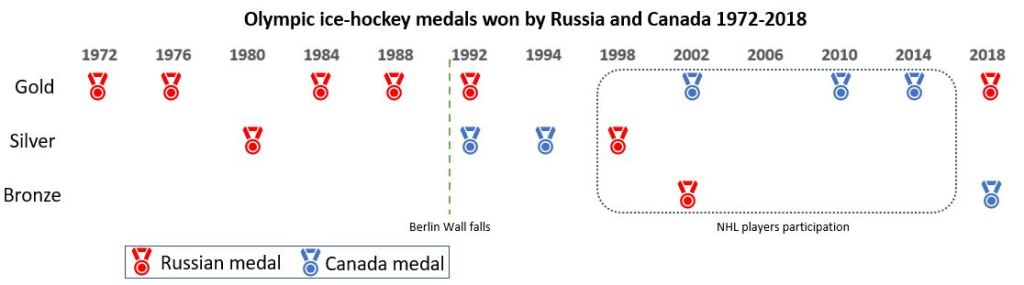
- While Russia totally dominated the Soviet era, winning four golds and a silver between 1972 and 1988, the fall of the Berlin wall was the start of a decline made worse when HNL players came onboard – in the five tournaments with NHL players, Russia failed to win a gold medal with only a silver and bronze for their efforts (although they returned to gold when the NHL sat out 2018).
- Canada only emerged on the modern hockey medal table after the fall of the Berlin Wall, winning two silver medals, but the real change happened when NHL players got involved – in those five tournaments Canda won three gold medals.
The diagram below shows how success ebbed and flowed for Russia and Canada over the years.
All this raises the question of how will the late decision by the NHL affect this year’s tournament?
Given that Russia and Canada have won 70% of gold medals since 1972 this probably tilts the balance towards Russia winning again. Of the others, Sweden would say they have won gold in both the NHL and non-NHL era so they will still be up for the challenge whatever happens. Similarly, while Finland have never won gold, they have medalled in five of the last nine tournaments, so they can perform regardless of what else is going on.
Finally, the decision by the NHL may open the door for another shock like Germany winning silver in 2018. Hockey may struggle to make an impact in Asia without the NHL, but Germany showed that the success of a smaller team can also be valuable to generate momentum for the sport in that country. Perhaps growing the sport in a country where there is already a small and committed fanbase might be more valuable than trying to chase more revenues in Asia.
 Sport.dat