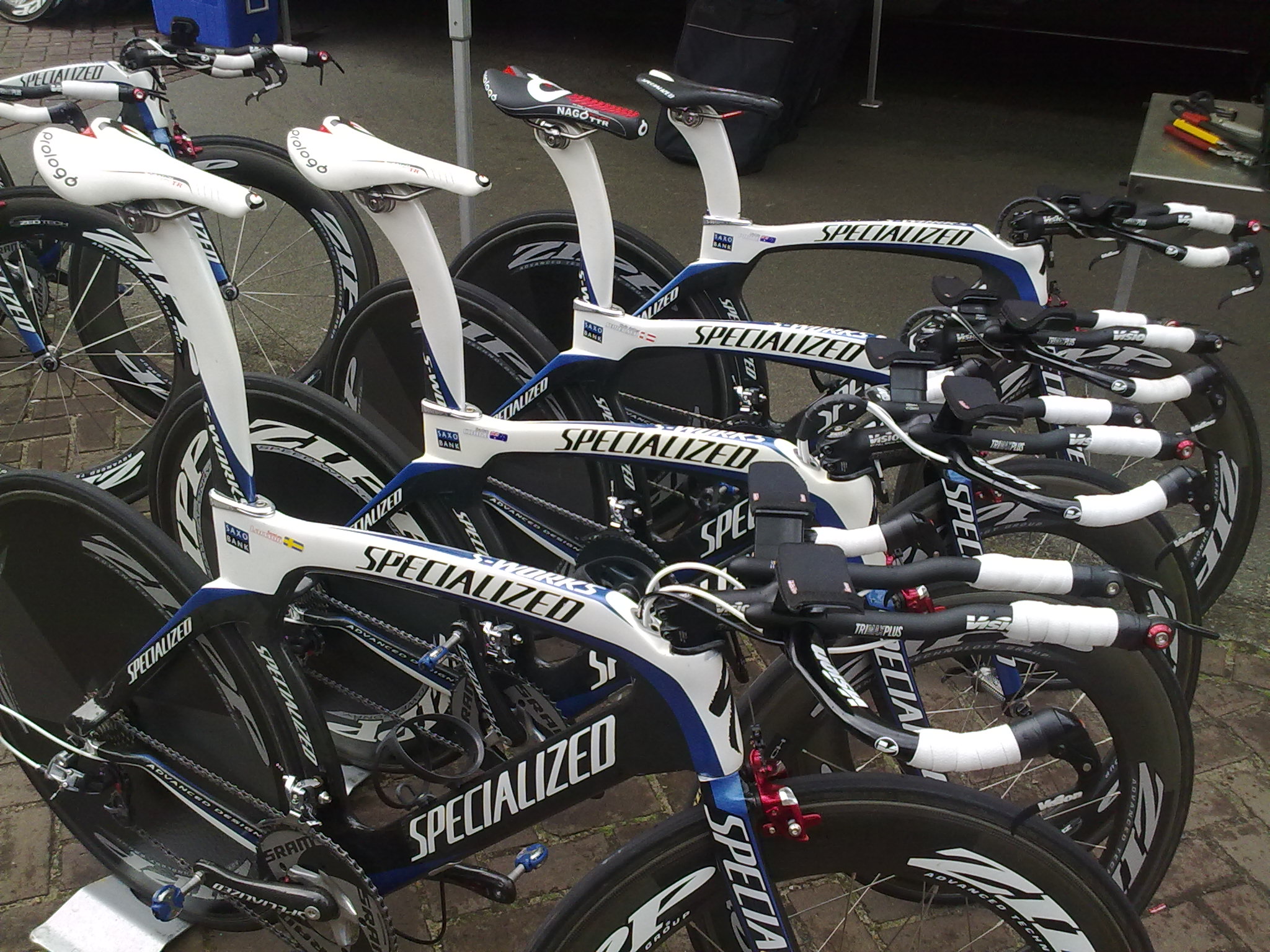
Shifting patterns in the ownership of pro-cycling teams

Comparing companies sponsoring cycling teams at the end of the last century with the shirts being pedalled around France twenty years later shows how the sport is changing. Ultimately the key to sustainability is to concentrate on cycling as a cultural ‘event’ rather than winners.

The rise of the US and UK teams has not brought the sponsors with it

This year marks 20 years since Lance Armstrong won his first Tour de France*. This marked a seismic shift in the history of the event as US and UK based teams would go on to dominate. However, while these victories increased popularity in the sport in English speaking countries this has not been met with a similar enthusiasm among companies willing to sponsor cycling teams.

*Lance Armstrong would later be stripped of all wins due to doping. As would his countryman, 2006 winner* Floyd Landis.

In 1999 there were two US companies and no UK and twenty years later there were two US companies and one UK. Not a huge return for 13 winners in 20 years. So what happened? Crucially a concentration of talent and a concentration of opportunity to exploit that talent has limited the appeal of the sport to sponsors.

  • While there are plenty of avid cycling fans in these countries, the sport gets little media attention outside the Tour de France. What matters for sponsors is to be associated with winners in the biggest event and they know they will struggle to get much traction from success in other races.
  • The winning strategy of these teams has been based on the superteam packed with quality riders rather than the traditional set up of one star rider supported by hard working domestiques. With talent concentrated in one team it limits the options for companies wanting to be associated with winners.

Shifting patterns in Europe

The fortunes of French cycling has been in sharp contrast to their English speaking rivals but here sponsorship is about more than just winning.  Here the number of French companies sponsoring teams has increased from 1999 (from five to eight).

This shows that while the Tour de France is now a global spectacle it is still France’s race and French companies want to be involved regardless of success on the road. The sport in France has managed to weather the storm of bad publicity caused by various drugs scandals in a way that other countries have not been able to do.

This is most notable in the shift of sponsors from South Europe to Northern Europe. Italy has gone from the home of the cycling sponsorship (around a third of all companies) to only 2 companies. While Spain has gone from five companies in 1999 to none. There is no doubt that bad publicity for the sport has played a role in this shift, but the global financial crisis has hit these countries hard. With households and companies having less to spend there is little incentive or appetite for sponsoring a cycling team.

Opening up new horizons

With limited interest from US companies and traditional leaders reducing the level of investment the future might have looked bleak for cycling. But saviours have emerged in the Middle East and further afield.  For example Tour winner Vincente Nibali tried to court pasta maker Barila to sponsor a team in 2014 but ended up with Bahrain.

For the money rich Middle Eastern and Central Asian states cycling sponsorship is part of a growing  use of sport in their soft power strategy to spread a positive message of the country – no different to any other sponsor except in what they are selling.

Finally, it is the English speaking countries of South Africa and Australia who are emerging as the new location of sponsors. This is a combination of teams looking to develop local talent on a global scale with sympathetic companies looking to be seen at home as supporters of national teams while also associating with globally important events. The growing international nature of the cycling calendar also offers these companies a second promotional opportunity as the cycling circus once only seen on TV comes to the other side of the world. 

The cycling ‘event’ is key to sustainablity

Professional cycling has expanded around the world. While races in the desert or Down Under may not always appeal to those in the heartland of the sport, it is providing a vital sponsorship lifeline as economic hardships constraint opportunities in established cycling countries. Alongside this the Tour de France remains the biggest event of all which is both a curse and a blessing. A singular focus on winning has reduced the potential pool of sponsors in some countries while for others, such as France, the event itself is so culturally important that sponsors will always be interested.

Winning may bring a small number of superteams and super sponsors but the sustainability of cycling relies more on the enduring appeal of the culture and beauty of sport and the ability to transport that around the world.

Are Premier league clubs gambling with shirt sponsorship

The recent decision by bookmakers William Hill to close more than 400 shops will reduce revenues to the sport of horse racing by an estimated £50-£60 million. The story is a cautionary tale for several football clubs about the need to plan in advance.

The rise and fall of Fixed Odds Betting Terminals

The story of reduced horse racing prize money starts with Fixed Odds Betting Terminals (FOBT). Basically, high value slot machines that became a license to print money for bookmakers. Only four terminals were allowed per shop, so the UK saw an explosion in shops openings across the country as bookmakers tried to maximise profits. By 2018 there were nearly 33,000 machines generating £1.7bn(1).

For the sport of horse racing this was a positive development. The sport is part funded through a media rights deal with bookmakers that pays £30,000 per shop -  so the more shops the more money.
But problems were on the horizon. FOBTs had a reputation for ruining lives, in part due to the speed with which they could separate a problem gambler from their money, and the evidence provided to government convinced them to act and reduce the maximum stake from £100 to £2.

The decision by the government in May 2018 was the beginning of the end for the good times of easy profit for bookmakers (although reports dating from October 2017 already showed the direction this was heading). The decision to close shops was an inevitable consequence but as Guardian journalist Chris Cook points out, no one in the sport seems to have noticed or planned for the loss of revenue, preferring instead to cross their fingers and hope for the best.

The sport can now expect to see an increase in the simmering conflict between horse owners and racetracks over the amount of prize money available.

The case of football

With the FOBT problem addressed, the next target for campaigners will be online gambling. Already bookmakers have voluntarily agreed not to advertise on TV during live football broadcasts, but how long before the government starts to regulate the advertisement of online gambling more closely? With perhaps the most obvious place to start being the shirt on the players back (or more importantly logo on the players front).

Gambling shirt sponsorship is worth nearly £50 million, or 1% of Premier League clubs turnover(2). But as is so often the case in the Premier League, removing the big clubs reveals a different story. While the ‘Big 6’ are supported by financial services, airlines and car manufacturers the remaining clubs have a much more eclectic mix of sponsors.

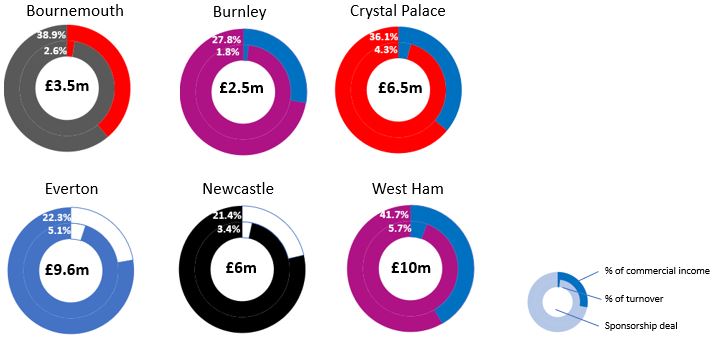
The six clubs who are sponsored by online gambling are shown below. Along with an estimated percentage of revenue accounted for by this sponsorship. While shirt sponsorship accounts for between 2% and 6% of overall turnover it does represent a significant proportion of commercial income for some clubs. West Ham receive over 40% of commercial income from gambling sponsorship, and Bournemouth 39%.

Figure 1: percentage of commercial income and turnover from gambling sponsorship

All figures based on 2017/18 data. Excludes Wolverhampton Wanderers who currently have a £5m gambling sponsorship deal but no premier league financial results for 2017–18

While TV revenues continue to make up the majority of turnover many of these clubs often flirt with relegation (Newcastle, West Ham and Burnley between them spent 156 days in the relegation zone last season) and a drop into the Championship will likely expose them to a greater dependence on their commercial revenue and its gambling connection.

What the future holds

It will be interesting to see how this story develops over the coming seasons. Online gambling is not a crime and it’s not going to be made illegal, but the promotion of online gambling is likely to come under greater scrutiny. With FOBTs out of the way, advertising is likely to be next on the list of campaigners’ targets.

Will these clubs follow the horse racing example and make hay while the sun shines, ignore the obvious winds of change coming from government, and then wake up one morning to the shock of reduced revenue?

If so, that’s when the scramble will start as seven clubs compete for new sponsorship revenue. Perhaps it’s time to get ahead of the competition and think about a gambling exit strategy.

Sources

(1) House of Commons Briefing Paper (2019) Fixed Odds Betting Terminals
(2) http://www.sportingintelligence.com/2018/07/30/manchester-clubs-lead-the-way-as-pl-shirt-sponsorship-climbs-to-313-6m-290701/ & http://www.theguardian.com/sport/2019/jul/05/talking-horses-everyone-a-loser-with-william-hill-closures-news

Welcome to My New Sport Blog

Starting the conversation with data

It’s amazing how two people can watch the same moment in sport and see two different things. You can guarantee that one person’s penalty was another person’s bad refereeing decision. Or for some it was genius, for others luck.

Such differing perceptions can maintain a conversation for ages, and even bring together strangers in a common interest. However how much of this conversation is based on any real insight and how is much is simply repeating the mantras of pundits paid to be controversial?

In this blog I hope to maintain the conversation, but from an angle based on data. Can this act as a starting point for interesting conversations? Of course data still has to be interpreted and different perceptions can emerge, but hopefully there will be some substance to the ideas and a trail of evidence to follow.

I’m just getting this new blog going, so stay tuned for more. Subscribe below to get notified when I post new updates.

Introduce Yourself (Example Post)

This is an example post, originally published as part of Blogging University. Enroll in one of our ten programs, and start your blog right.

You’re going to publish a post today. Don’t worry about how your blog looks. Don’t worry if you haven’t given it a name yet, or you’re feeling overwhelmed. Just click the “New Post” button, and tell us why you’re here.

Why do this?

  • Because it gives new readers context. What are you about? Why should they read your blog?
  • Because it will help you focus you own ideas about your blog and what you’d like to do with it.

The post can be short or long, a personal intro to your life or a bloggy mission statement, a manifesto for the future or a simple outline of your the types of things you hope to publish.

To help you get started, here are a few questions:

  • Why are you blogging publicly, rather than keeping a personal journal?
  • What topics do you think you’ll write about?
  • Who would you love to connect with via your blog?
  • If you blog successfully throughout the next year, what would you hope to have accomplished?

You’re not locked into any of this; one of the wonderful things about blogs is how they constantly evolve as we learn, grow, and interact with one another — but it’s good to know where and why you started, and articulating your goals may just give you a few other post ideas.

Can’t think how to get started? Just write the first thing that pops into your head. Anne Lamott, author of a book on writing we love, says that you need to give yourself permission to write a “crappy first draft”. Anne makes a great point — just start writing, and worry about editing it later.

When you’re ready to publish, give your post three to five tags that describe your blog’s focus — writing, photography, fiction, parenting, food, cars, movies, sports, whatever. These tags will help others who care about your topics find you in the Reader. Make sure one of the tags is “zerotohero,” so other new bloggers can find you, too.

Design a site like this with WordPress.com
Get started