Has the lockdown changed the future relationship between sport and eSport?

One way to think of the current lockdown is that it is a period of ‘accelerated evolution’. People have been forced to dramatically change their way of life (a mutation) and if these new habits are useful when things get back to normal then they will become trends, with less useful mutations being resigned to history.

For example, businesses are seeing the value of remote working and this is a change that is likely to stay. Whereas all those shiny new bicycles will be back in the shed when the wind and rain returns, car traffic increases and if local authorities have only piecemeal investment in cycling infrastructure (as an aside, painting a bicycle on a footpath is not an investment in cycling infrastructure!).

This idea of accelerated evolution made me think of eSports, a trend that has been hanging around the outskirts of sport for a while as professional clubs and leagues try to work out if it is a threat or opportunity.

The opportunity is that eSports is popular with the young demographic sports marketeers are so keen to attract, but is it really the same thing as what happens on the pitch, court etc? Is it something you can use to increase your fanbase, or is it a competitor?

Many clubs have already invested in eSports, both for sports and other eGames, but this is a fraction of their total spend and feels more like an insurance policy in case it really takes off.  

However with supporters in lockdown there has been a rise in interest for using eSports in more traditional setting as Sports try to maintain a link with their fan bases. For example, in the last two months

  • Formula E established an online series for their drivers and one for sim racers
  • NBA teams have streamed virtual versions of the games they would have been playing each night had the season not been suspended
  • The NHL created an online Challenge tournament for existing players

This is a new type of eSports, it is aimed at linking fans with the club/sport while the real action is missing, rather than investing in professional eSports players or leagues. But in this world of accelerated evolution will it be a successful mutation, or something that falls by the wayside when the real-life action returns?

Eventually there may be a cross-over as both sport and eSport learn from each other, but this is a longer term evolution rather than the accelerated evolution of our lockdown experience.

While that is an impossible question to answer, it does show the dilemma for traditional sport when thinking about eSports. Is it about connecting real-life sport to the virtual world (becoming an augmented reality experience) or is it a discipline in itself, with gaming leagues and stars existing separately to sport (and often in competitions that are not sports but games like League of Legends)?

Your answer to these questions probably depends on your own views on sport. For me, I suspect this virtual experience is a short-term answer to a problem and is a mutation that wont last when the live action returns. Meanwhile eSports will continue to grow in its own world and will emerge as a threat to Sports that are looking to connect with a younger generation.

So sport and eSports are on different trajectories to the future, and for a club or league the best strategy may be to think short and long term. Imagine the current situation as a mutation that wont last when the live action returns but is still useful to keep fans engaged. Longer term, professional eSports is different and it is a threat that is best handled by embracing it and investing in players and leagues now.

Eventually there may be a cross-over as both sport and eSport learn from each other, but this is a longer term evolution rather than the accelerated evolution of our lockdown experience.

Looking for a champion to emerge in the shortened flat racing season

With Epsom racecourse getting the go-ahead to run the Derby in July it looks like this year’s winner will be in the record books without an asterisk to denote the race was not held at Epsom. This is important for future breeding potential as the Epsom Derby is regarded as the pinnacle of what a breeder looks for in a horse – balance, speed, stamina and that special determination that separates the great from the greatest.

As the famous Italian breeder Federico Tesio said “the thoroughbred exists because its selection has depended, not on experts, technicians, or zoologists, but on a piece of wood: the winning post of the Epsom Derby.”

However, even though it appears like the classics will be run this year, there is still a fear that a  classic winner will be overlooked as any victory happened in such an unusual condensed season.

The condensed summer flat racing season is not just an issue for the breeding industry, horse-racing has a multitude of fans who spend each winter dreaming of being able to see the next champion. Anyone who had the chance to be at a racecourse when Frankel ran would appreciate how much importance fans place on being able to say they remember (or saw) the greats in action.

In this shortened season there will be less chances for fans to get to see the classic three-year old generation (especially when they can’t visit a racecourse) so more familiar juvenile champions from last year will likely play a greater role in the public consciousness.

What are the prospects of last year’s two-year superstar Pinatubo emerging to fill the role of champion?

Described as ‘potentially outstanding’ by the British Horseracing Authority’s lead two-year old handicapper, Pinatubo produced some of the best performances of the last twenty-five years. But how likely is that to convert into classic success?

Since another potential superstar in Arzai was named 1991 Cartier Champion Two-Year Old, just over a quarter of champion juveniles have gone on to Classic success. Eight out of 29 horses went on to win an English classic, rising to 11 when you include French and Irish Classics. So the odds are not in Pinatubo’s favour.

But there is a glimmer of hope for those desperately wanting a good story to emerge in racing this summer. When grouping results in five years intervals it shows that the last 15 years have been more successful for younger horses graduating to classic winners – closer to a 40% chance than 25%.

The performance of Cartier Champion Two-Years in their three-year old season

Note: performance was based on a points system of two points for winning the English 2,000 Guineas or Derby, one point for a French/Irish classic or English St leger, and half a point for being placed in a classic.

These have been the years of Frankel, Dawn Approach, Kingston Hill, Gleneagles, and Churchill, so hopefully Pinatubo will follow that line, rather than the super-speedy US Navy Flag and Too Darn Hot who never quite lived up to the hype.

The reasons for this more recent trend could be better breeding, training methods or understanding of young horse development.  Or it may just be random variation rather than a trend at all.  But horse racing is built on hope, from multi-millionaires to the small punter or fans, so I suspect most fans will be hoping to see a continuation of a new trend, and a new champion to look back on this season with happy memories.

The Motivation Factor in Football

Could the Premier League’s New Normal offer a glimpse of hope for Norwich?

Anyone who has had a football bet on a Saturday afternoon will be familiar with the old adage that towards the end of the season upsets happen as teams fighting for survival are more motivated than mid-table secure teams.

Of course if this was true we would all be rich from gambling. But in reality there are still a number of factors that influence a result beyond how motivated a team is.

As the Premier League grapples with how to finish the 2019/20 season perhaps The Motivation Factor will finally have its day.

Despite all the statistics and ‘R’ numbers flying around the media, the coronavirus crisis in a human crisis and footballers are as human as anyone else (as report of players being worried about the safety of the return to work shows). With games at neutral venues, or at least behind closed doors, there are less external influences on a player and it is possible internal motivations will be more important. After all, how motivated will you be to play a game that has little impact on your league season but could affect your own, or your family’s health.

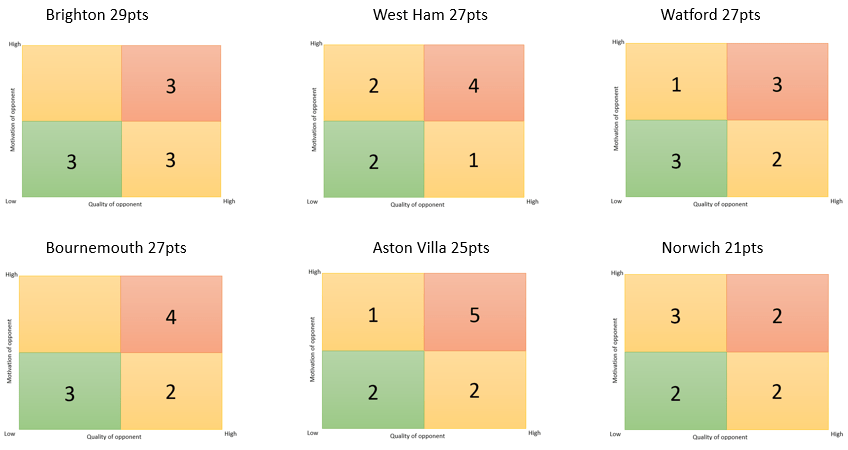
With that in mind, I looked at the remaining games of the bottom six Premiership teams to asses the motivations of their opponents. The idea being that there are points to be won from a motivated team playing a less motivated team. For each team I gave a motivation rating depending on how close they were to relegation or a European place.

I also wanted to take the quality of the team into account, as I suspect a top quality team just going through the motions are still a tricky proposition for relegation strugglers. So each team also received a quality rating based on their current season performance.

Taking these two rating together (motivation and quality) allowed me to map each team’s opponents onto a four-box model as shown below. Put simply, playing a highly motivated, top quality team did not offer much chance for a win, while playing a demotivated poor team was a ‘should win’ game. The other two probabilities shown below are tight games and potential upsets (playing a good but de-motivated team).

Potential outcomes based on quality and motivation of opponents

The opponents of the bottom six as seen through this lens is shown below.

Final season fixtures based on the number of opponents in each quadrant

So what conclusions can we draw?

In reality these graphs would change game-by-game as motivations would alter as league placing change each week. But looking forward from now we can say…

Brighton have enough easy games to stay out of trouble.

West Ham are not going to have it easy as two-thirds of their games are against highly motivated teams – and a lot of them are good teams.

Watford have an easier run-in than West Ham and should be confident of overtaking them.

Bournemouth have enough ‘should win’ games to see them get out of the relegation zone.

Aston Villa may have a game in hand but they also have one of the hardest run-ins.

Norwich might possibly escape if they can win all those tight games.

Based on the above, West Ham are probably in the most precarious situation and may be hoping there is no restart to the season.

Will sporting integrity outweigh Premier League club self-interest?

Analysis of the outcome of different ways to end the 2019/20 Premier League season suggests some clubs might have very different objectives for upcoming talks on restarting football.

As the Premier League meets to find a resolution to the season, almost everyone is hoping there can be some way to finish the remaining games of the season. However should the worst happen and the season has to be ended now, who would be the winners and losers?

Here the focus is not on runaway winners Liverpool, but rather those chasing the riches to be won in Europe.

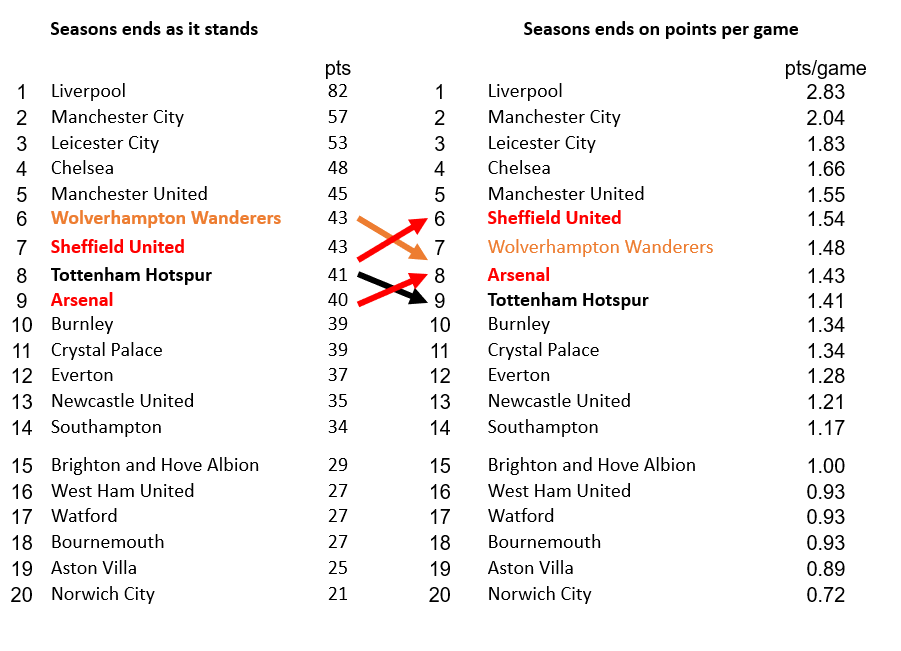
The problem for the Premier League is that four team have played 28 games while the others have all played 29. Using the standings as they are now will disadvantage four teams so the most likely course of action would be a points per game league table.

How things change on a points per game basis is shown in the table below.

The table above shows how Wolves would be the losers in this situation, dropping from sixth to seventh and failing to qualify for the Europa League. The beneficiaries are Sheffield United, who move up to sixth, thanks to having the same amount of points but having played one less game.

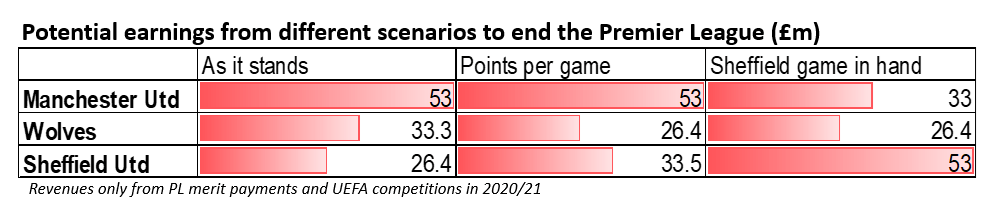
Financially, that is a swing of nearly £7m for Sheffield United thanks to extra merit payments from the Premier League and UEFA payments next year (this assumes they reach the group stages of the Europa Cup and win two games and draw one). Meanwhile the reverse is true for Wolves.

The only other teams who would reverse places as a result of a points per game calculation are Tottenham and Arsenal. This would mean an additional £1.8m for Arsenal but really for fans, the chance to finish above their North London rivals is valued much higher.

Are there any teams who would want the season to end now?

So the winners of the points per game calculation are definitely Sheffield United and Arsenal. But are there other teams secretly breathing a sigh of relief if there is no way to solve the ‘games-in-hand’ problem?

Manchester United are possibly in that bracket. Had Sheffield United already played and won their game in hand, it would be the Blades heading into the Champions League next year. Forget the additional £7m, the Champions League would be worth more than £50m to Sheffield United. For Manchester United this reversal would see a drop in revenue from more than £55m to £33m (Manchester United would earn more than Sheffield United in the Champions League because of the system of rewarding larger clubs extra payments). And none of this includes the money from TV, ticket sales and sponsorship incentives associated with playing in the Champions League.

So perhaps Manchester United officials won’t be searching too hard for creative playing solutions to end the season, and will be lobbying for a ‘sensible, safe’ choice of the points per game system. They may take a hit on TV revenue for the rest of Premier League season, but would be looking forward to Champions League football next season.

They might also find a couple of other clubs in agreement with this plan. Most notably Watford, who could be relegated if Aston Villa won their game in hand and jumped out of the relegation zone. West Ham and Bournemouth would also both move down a place and lose nearly £2m each, which would be quite a chunk of money for teams already struggling to pay staff during a lockdown.

However, for the clubs at the bottom of the league it is less about differing prize money caused by how the league is decided, and more about the loss of Premier League riches next year through relegation.

Of course, this is all hypothetical, and who’s to say that Sheffield United or Aston Villa would have won their games in hand. There’s even a scenario where Arsenal end up in Europe! But if the will is there, clubs could start to brainstorm some creative ideas – for starters how about a play-off to solve the Champions League place between Manchester United and Sheffield United, and a relegation mini-league?

What matters to clubs?

What this analysis does suggest is that different clubs might approach the tricky question of how to end the season with very different views on what would be the best outcome – for the game and for them. Ultimately it comes down to the question – does sporting integrity outweigh individual club interest?

Hopefully it won’t come to boardroom negotiations and everything will be settled on the pitch. Better that, than Aston Villa supporters lamenting how they got relegated by 0.04 points.

Note: this blog assumes that Manchester City are still excluded from next year’s Champions League and the team in fifth place in the Premier league will take their place.

What to do about ever increasing driving distances in golf

Imagine a fictional three ball featuring top golfers from 1900, 1930 and today. On the first tee our 1900’s golfer is happy to send the ball 180 yards down the fairway, although he’s not so happy when he sees the 1930’s player knock his drive 60 yards further to 240 yards. However, both are down-hearted when our modern-day professional’s ball ends up almost 300 yards down the fairway (294 to be precise). That’s almost 120 yards further than the turn of the twentieth century – practically one yard further for each year.

This data comes from a report by the USGA and R&A, both of whom are getting increasingly worried about how far modern players can hit the ball and what this means for the game. Particularly for golf courses built to test players from the nineteenth and twentieth centuries.

The image below shows the impact of this increase in driving distance among elite male players. Not just looking good with big drives, but longer drives mean easier approach shots and better birdie opportunities.

Average driving distances for elite men in 1900, 1930 and 2019

The jump from 1900 to 1930 was in large part caused by a shift to the wound rubber core gold ball, but across the ages it has been a combination of ball, club and player improvements that have increased average driving size.

So what’s to be done?

There’s little you can do to stop players getting stronger and fitter, so focusing on the technology seems like an obvious answer. However, you get the feeling that you will never really stop technological progress so much as put up a barrier that R&D will eventually find a way around. Golf equipment companies are in competition to sell clubs that make you better and this arms race will inevitably increase how far their clubs can drive whatever ball is put in front of them. So the problem will return again soon enough.


Perhaps another option is to return the player and focus on the mind. One example would be to re-designate Par 5’s as Par 4’s for elite competition. It’s easy to have a go with a big drive on a Par 5 when you know that if your drive is off target you can knock it out sideways and still reach the green in regulation. A professional playing a golf course with three Par 5’s is basically playing with a handicap of 3. Remove these free shots and the mind set changes and you’ve made the game harder without changing any technology.


This won’t reduce how far a player can hit the ball (and the reduction route is unlikely to be a long term viable option anyway), but it will provide some protection for courses without resorting to US Open style rough that completely stymies the excitement of birdie golf. It strikes a balance between risk and reward which is fundamental for good golf course design.

This is probably the most straightforward idea that doesn’t try to manage the technology, or the companies who put a lot of money into the game. It also has the advantage of being easy to test. It may prove to have a negligible effect, but it wouldn’t cost much to find out either way, and it may lead to other experiments that tackle this problem from a less obvious direction.

Why are top Premier League teams earning so many points?

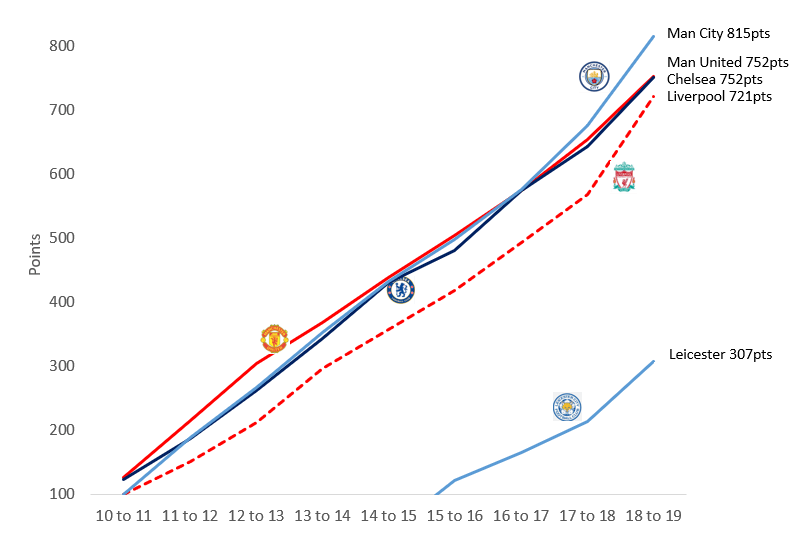
The most successful Premier League team of the decade has undoubtedly been Manchester City, with four league titles and two FA cups. But another interesting stat is how they came to earn 63 more points than their nearest rivals in those years.


The graph below shows the cumulative points won by the Premier League champions of the decade. At the end of the 2011 season (and including points won in 2010 from the 2009/10 season), City were 27 points behind champions Manchester United. By 2013 this had extended to 38 points, but by New Year’s Eve 2019 this had swung to a 63 point lead for City.

Cumulative points won from 1st January 2010 to 31 December 2019

One of talking points of the decade that this analysis has raised, is how in the closing years of the decade, teams have started winning over 90 points, and even into the 100’s? Before 2017, no team had scored 90 points but in the last three seasons, four teams have achieved this, with more big points hauls expected by the end of this season. You can see this in the sudden change in angle on the points line for clubs like Manchester City and Liverpool.


The question is, if the Premier League is getting more competitive, and anyone can beat anyone else, as we’re told by broadcasters and pundits, why has the average number of points for champions gone from 85 between 2011-2016, to 97 between 2017-19?

A second interesting question is raised by a team much lower on the graph, Leicester City. They may only have 307 points earned this decade, but they have one thing most teams don’t have, a Premier League title. So what is more important, the accumulation of points to earn more money, or a season of glory? As a supporter would you rather have one winning season or 10 seasons of qualifying for the Champions League?

So what does the next decade have in store?

Surprisingly, the happiest supporters on the 1st of January are those who support a team with no domestic trophies and only the fourth highest points total – Liverpool. The reason is shown in the graph above by how their points accumulated line has angled up dramatically since 2017. Supporters love to remind opponents of their glorious past, but like most sports, people are driven by future hopes. Liverpool are one of the teams in the 90+ points club, and with a Premier League title almost in the bag, it looks like Liverpool and Manchester City will be the powerhouses of the early twenties.

Beyond that I wouldn’t like to say, just look at the fall from grace of the 2011 champions Manchester United.

Stats suggest an England World Cup win

England beating New Zealand in the Rugby World Cup semi-final was a ‘shock’ that even had non-rugby fans talking on Saturday night. But looking at some tournament performance figures was it really such a shock?

The graph below shows tournament points scored per minute and points conceded per minute for the four semi-finalists (only against Tier 1 opposition). Before going into the individual games, you can see that the England-New Zealand game looked better quality with higher scoring, while Wales were the outlier of the quartet as they scored less and conceded significantly more. Indeed, I was cheering for Wales as this would have created a final of stats versus the fairytale ending that sport can often through up.

Points scored per minute and points per conceded per minute against Tier One nations in RWC 2019

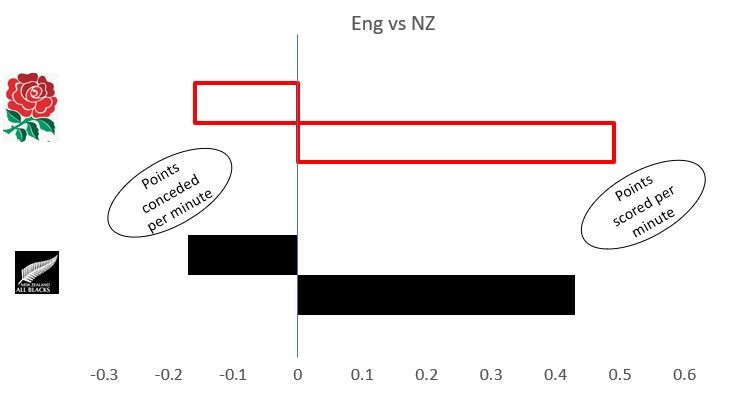
In the first semi-final England had the slightly better figures with a tournament average of scoring 0.49 points per minute (pM) and conceding 0.16 while New Zealand scored 0.43 pM and conceded 0.17. Over 80 minutes this would be a 5-6 point advantage.

Points scored per minute and points per conceded per minute prior to semi-final: England vs New Zealand

Of course, if everything worked out neatly by the numbers rugby would be a dull game, but the numbers do suggest this was not as a big a shock as people think.

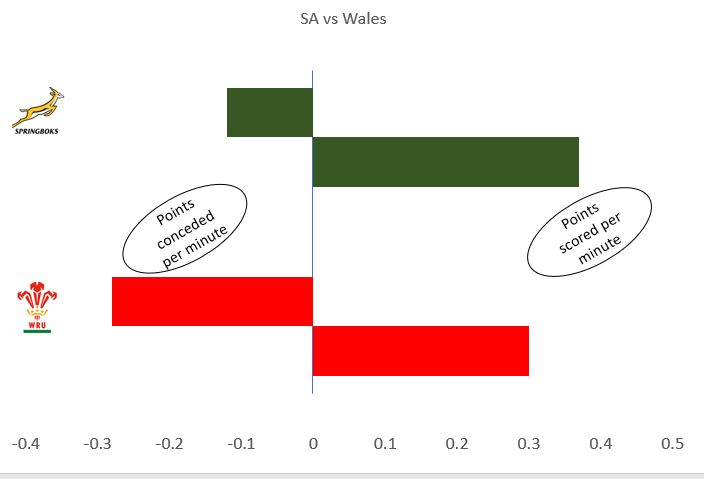
As for the second game, you could argue Wales did well to keep it as close as they did as the stats pointed to a much a larger South Africa victory because the Welsh points conceded per minute was more than double that of South Africa. It is this fighting against the odds that probably characterises the Welsh World Cup journey.

Points scored per minute and points per conceded per minute prior to semi-final:  South Africa vs Wales

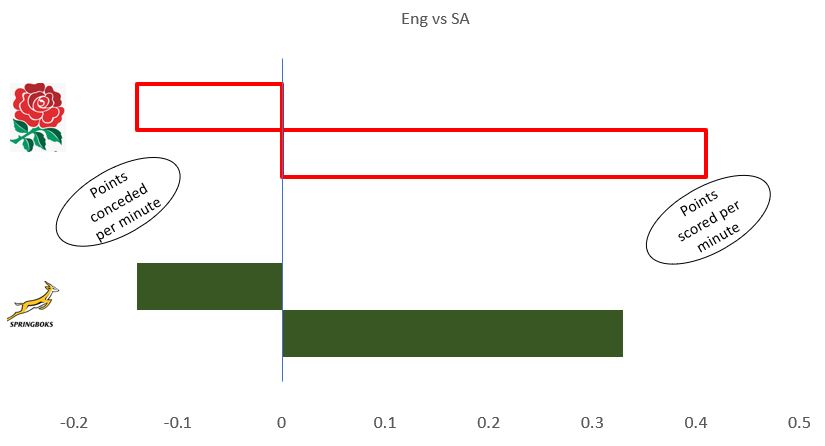
And so to the final. Updating the figures from the semi-final gives England the edge. While the points conceded are the same for both teams, England average 0.41 points pM compared to South Africa’s 0.33 – a difference of six points over 80 minutes which is just below the rugby world cup final average of seven.

Points scored per minute and points per conceded per minute prior to final:  England vs South Africa

I’m hoping that at the end of the game we’re talking about the points scored per minute stat rather than the points conceded per minute. The former probably means a great high scoring game while the latter means a dull game of attrition which is ‘one for the purists’.

Of course, if you’re a winning England or South African fan you certainly won’t care how you got there.

The next wave of cycling superstars

I started putting work together on this blog by asking the question ‘are we seeing the rise of the disruptor in cycling?’ In the last two years there had been Grand Tour winners aged 22, 26 and 26 and a number of exciting young riders animating races. It felt like a new era was emerging to challenge the status quo.

However, the data soon told me that, with the exception of 22 year old Egan Bernal winning the Tour de France, the last few years have not been that unusual. The graph below shows the age of the winners of each of the Giro d’Italia, Tour de France and Vuelta a Espaina going back to 1989. While the winners are most commonly aged between 28-32 years old, it is not that unusual to see a 25 year old winning a grand tour, 20% of winners have been aged 25 or under (although that is less likely in the Tour that has been dominated by multiple winners gradually getting older).

At 22, Bernal is significantly younger than these other winners, but only the future will tell if he is another outlier like 41 year old Chris Horner who won the Vuelta a Espania in 2013.

Figure 1: Age of Grand Tour winners (1989-2019)

However, the data suggests we might be at the start of a new wave of grand tour winners, and a younger wave at that. The bar chart below shows the average age of Grand Tour winners each year since 1989, and it does seem to move in a series of waves as generations come and go (this is helped by multiple winners who push the average age up each year). If 2019 is the start of another wave, the average of 26 years old is certainly a change from the previous 11 years when these waves tended to start at an average age of 29 or older.

Figure 2: Average age of Grand Tour winners

In fact, you would have to go back to 1997 to see another era of young winners. However, lets hope that if this is a new era, it will not will not be a replica of that late 90’s group that included the young Jan Ulrich and Marco Pantani.

Endorsements have rocketed but still return on investment

Reading the excellent Shoe Dog by Phil Knight gives a new perspective on sports giant Nike. Usually when you think of Nike you think of a global corporate giant that controls every facet from design to manufacturing to marketing. But reading Knight’s memoir of where it all started you get the origin story. Nike the start-up being run out of a bedroom, living in a constant state of debt with no equity, and driven forward by a small team of passionate and dedicated people.

One measure of the phenomenal growth is to look at endorsement deals. The figure below shows some of the seminal Nike deals, from Ilie Nistase’s $10,000 in 1972 to Derek Jeter or Rafael Nadal’s $100,000,000 in 2008. Of course the nature of these deals has changed to become multi-year, multi-layered agreements but it is interesting to think how conversations around the table change as you grow.

Figure 1: Selected Nike endorsement deals 1972-2008

The winners in the endorsement world

But the investment is worth it. One piece of research found that when Tiger Woods endorses a brand it leads to a price premium of roughly 2.5%. As a result, approximately 57% of Nike’s investment was recovered just in US golf ball sales alone.

Looking from the other side of the table this growth is good for athletes too, and even more so for their agents. With agents often taking about 10% of any deal you’re basically removing one zero from those figures above. In the 70’s and 80’s that seemed like a fair deal for what’s involved, but 10% of $100m is excessive even for the more complicated nature of the deals.

Small Cities – Big Winners

Since Padraig Harrington won in the British Open in 2007, Irish golfers have won 20% of golf’s Majors. This is quite a haul for a country with a population of 6.6m people and begs the question of how country demographics helps talent develop?

Small is beautiful

Research from Canadian academic Jean Cote and colleagues provides some interesting evidence that where someone is born can influence success.  Taking the example of golf, Cote showed that while just over a quarter of boys under 14 in the US live in cities of under 50,000 people, more than 45% of PGA Tour professionals were born in cities with a population under 50,000.

For Irish golfers who have won majors the figure is ever higher with four out of five (80%) being born in cities with less than 50,000 people. Similarly of the ten Irish Majors since 2007, seven have been from players born in cities of less than 50,000 people.

Of course this data doesn’t prove that small cities produce better golfers. But what advantages might these smaller locations provide, not only for golfers but also for other sports examined in the research including baseball, basketball and ice-hockey.

The researchers argue that smaller cities provide more intimate and informal environments to nurture talent. There is more social support, less structured programmes (that are almost inevitably required in big cities), and less conflict with others that can negatively impact on feelings of self-efficacy. Conversely it is easier to find success in small cities which will positively impact on self-efficacy.

The virtuous circle of small cities

By providing a more supportive and less structured environment smaller cities create more satisfying experiences of sport. This encourages young people to play more and therefore develop their skills. In addition, there is a Pygmalion effect were early success increases other people’s expectations and makes young people believe in themselves and practice more (and develop more etc).

Location is not all that matters

Growing up in a small city is not a magic recipe for success. My inability to get my handicap below 12 was not because I grew up in a larger city but rather because I lacked the skill and application. Smaller cities do not make Major champions, but they do seem to provide an environment where talent (or whatever it is that makes champions) does not get lost as quickly as it might in a bigger city.

Irish winners – the details

The five Irish winners of Majors since 2007 include:

Rory McIlroy (4 Majors) born Hollywood pop.12,000

Darren Clarke (1 Major) born Dungannon pop.16,000

Graeme McDowell (1 Major) born Portrush pop.7,400

Shane Lowry (1 Major) born Clara pop.3,000

Padraig Harrington (3 Majors) born Dublin pop.1,350,000

Design a site like this with WordPress.com
Get started