Racing ahead with TV ratings

Horse racing was one of the first sports to restart in the UK after the lockdown, and looking at the TV viewing figures, it seems to have taken advantage of the empty playing field.

The figures for three of the biggest events in the racing calendar (the 2,000 Guineas, Royal Ascot, and the Derby) shows that TV ratings have ranged from 11% and 94% higher this year. What is most encouraging for the racing industry is that even as the rest of the sports and entertainment industry started to catch up, racing has maintained above average performance.

The largest improvement in viewing figures was the 2,000 Guineas: nearly 1.5m watched the race on TV this year compared to around 750,000 in 2019 (a 94% increase). The race was run on 6 June, so the competition was limited mainly to snooker and the Bundesliga, so it is not surprising that the figures were so high as people were looking for sport to watch (and bet on).

Royal Ascot traditionally has a lower viewing figure as it takes place mainly during the week, but it was still 14% up on last year. Most importantly their Saturday fixture, which coincided with the Premier League restart on daytime TV, still showed a healthy 11% increase.

The Derby is the highlight of the racing calendar and this time around it faced competition not just from the Premier League, but also the re-opening of bars and restaurants in England and Northern Ireland. Despite these distractions, the race managed 2.3m viewers, up 31% on the previous years.

What happens next?

The big question for racing is what happens next? The late start to the season had created a frenetic period when the early season calendar was condensed into a few weeks and the big races just kept coming. Now this feast is over and most of the marquee events have passed, will racing be able to maintain the interest of viewers who have more and more alternative options available?

Hopefully, the racing coverage will have created new fans who continue to watch at least the big days.  While a typical Saturday racing on TV may struggle to maintain the audience, it will be interesting to see how events like Glorious Goodwood, the Ebor Festival, and Champions Day compare with last year.

At the end of the season it would be useful to study the figures for the season in detail and see what lessons can be learnt. In particular, is it the product that racing can offer, or the actions of other sports/activities that had the most influence on TV ratings?

An experiment in forecasting Premier League relegation (Part 2 – bad teams are really bad and embracing the uncertainty)

When the Premier League restarted I decided to develop a model to predict relegation. The model was based on an assessment of the quality of the opposition and their likely motivation. Four rounds of games might be a bit early to re-assess things, but I think I have learnt enough to make some revisions. After all, learning about what works and what doesn’t has always been the reason for doing this – and there are only 10 games in total to work with.

My main points of reflection to date include:

  • There is not much you can do about a 9000-1 shot such as Hawkeye not noticing that the ball was obviously over the line in the Watford-Sheffield Utd (an event Hawkeye later apologised to Sheffield Utd about). This got Watford a point that was not predicted.
  • I won’t complain about 93 minute winners because that’s part of the game, and I’d just sound like a loosing punter, but as with the Hawkeye, there is a need to take into account unpredictable events.
  • For both the reasons above I’ve decided to go for a spread of points in the prediction. You can look upon this as a cop out or as a more realistic assessment of an unpredictable future.
  • Perhaps more importantly, I’ve learned that bad teams are bad teams for a reason and I originally over-estimated the value of motivation. The old adage that a motivated poor team will beat a less motivated better team does not seem to hold true, especially when the bad team are really bad. The calculations for future points are now more closely related to past performance.

The new predictions

So what does this mean for the new predictions? In the table below you can see the changes from the original Version 1 to the new Version 2 that was created after four rounds of games.

The predicted points for most teams have been reduced to reflect their own abilities and only the ranges for Brighton and West Ham are still within the original predictions. West Ham are the big winners, with the model predicting they have moved clear of relegation worries. This is mainly due to getting through their difficult restart better than expected and the poor performance for other teams around them.

The losers of this re-calculation are Watford, Bournemouth, Aston Villa and Norwich, although Watford should still be safe. Bournemouth were originally predicted to stay up by a whisker but anyone who has seen them lately will know that any model would struggle to justify that.

One other interesting note is how using a points range helps to show the level of uncertainty that inevitably emerges in sport. If Watford perform at the lower end of their range and Aston Villa at the higher end, then relegation could be decided on goal difference, or even the lucky bounce of a ball in injury time of the last game!

It is these uncertainties that make sport, and trying to predict it, so compelling. Rather bizarrely, adding greater uncertainty to the prediction has probably made it a more accurate model.

Derby Dynasties: how one breeding line came to dominate Epsom

Owning or breeding an Epsom Derby winner is perhaps the pinnacle of horse racing on the flat, and the good news for any multi-millionaires out there is that things are getting easier. The last fifteen years has seen a concentration in the number of sires producing winners.

In the fifteen years from 1990 to 2004 the winners of the Derby were sired by 14 different horses, but in the last fifteen years this has reduced to just 8 (a 43% drop). Similarly, the variety of grandsires has reduced from 10 to 7.

The two horses most responsible for this trend are Galileo and Montjeu with four winners each (and who knows how many winners Montjeu would have sired had he not tragically died in 2012).

These two brothers are just the latest part of a Derby Dynasty that goes back to their father Saddler’s Wells, and their grandfather, the most influential sire of them all Northern Dancer. In the last fifteen years Saddler’s Wells has been the grandsire of more than half of Derby winners while Northern Dancer appears in the pedigree of all but one winner.

However for all their appearance in winning pedigrees, neither of these great stallions dominated as sires in the way Galileo and Montjeu have done recently – Saddler’s Wells had two winning sons (Galileo! And High Chaparral) while Northern Dancer had three in the 70’s and 80’s (Nijinsky, The Minstrel and Secreto).

The question that remains is why, or how, did Montjeu and Galileo manage to become such a dominant force in a way their father and grandfather never did?

At one level is the point that Coolmore, the owners of Galileo and Montjeu, invest heavily in helping their sires produce Derby winners. They spend a lot of money to secure top juveniles that continue the family line, and spare no expense in getting them trained by the best around. Their love of the Derby, as much as their love of the breeding business, also ensures their vast resources are concentrated towards the race.

Coolmore started by selecting horses from a great Derby sire in Northern Dancer, and by controlling the breeding, produced Montjeu and Galileo. They are the product of selective breeding from a horse with all the attributes of a derby winner, and a group of owners with a specific goal in mind – the winning post at Epsom.

But even with all this, winning the Derby isn’t solved by throwing money at the problem and there are still a lot of rich owners and talented trainers out there – not to mention amazing horses with blue blood coursing through their veins.

Why this dynasty is so good at passing on the Derby winning genes remains a mix of breeders’ intelligence, experience, intuition and good luck – the exact mix of which remains uncertain.

It is this element of mystery in breeding and racing that makes it so compelling and provides the possibility that a new champion can always be waiting in the wings.

At the minute Galileo is at the top of the pack, but the history of the thoroughbred is one of evolution. It will be interesting to see if another comes to dominate the Derby or if we return to a broader spread of sires from a broader range of families.

Will the dynasty continue in 2020?

As for this year’s renewal, a victory for the favourite English King would see a new sire added to the list, although Camelot is a son of Montjeu. However second favourite Kameko adds a new dimension with his American sire Kitten’s Joy (although go back far enough and you will find Saddler’s Wells and Northern Dancer).

After that comes the Galileo army, with the next three in the betting (Russian Emperor, Mogul and Vatican City) all being sons of Galileo.

Liverpool are setting new records in the Premier League

There is an almost comic irony about the fact that Liverpool set a new record for wrapping up the Premier League in the shortest time during a season that will go down in history as the longest ever.

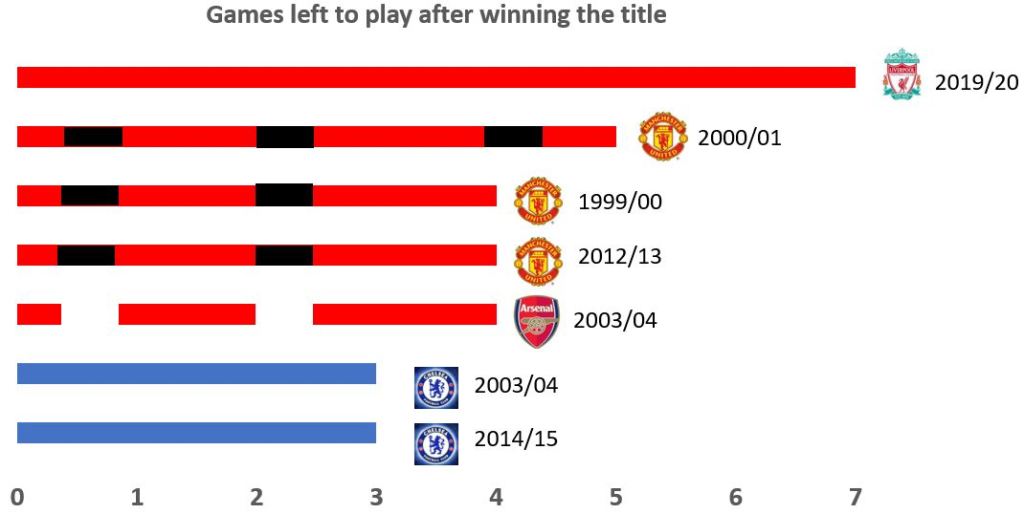
When Manchester City lost to Chelsea on Thursday night it meant Liverpool had won the league with seven games left. This eclipsed the previous record of fives games to spare which had been held by Manchester United for nearly twenty years.

United remain the experts of the early season wrap up though, as they have won the title with five games to spare once, and four games to spare twice. The Arsenal Invincibles also managed to win the title with four games to spare while Chelsea have twice won with three games left.

Other records up for grabs

The next question is how many records Liverpool will go on to break this season? If they keep the accelerator on they will smash Manchester City’s record of 100 points in a season, getting closer to 104 or 105 points. They can even afford to slow down and still break the record. Currently their points per game is 2.77, and they only need to maintain a 2.14 average to collect over 100 points.

Whether they break 100 or not, you would expect them to maintain the new trend in the Premier League of 90+ points required to be champions. Since 2016/17 the average winning points total is 97, compared to 85 for the early part of the last decade.

Lockdowns, eSports and an experiment in football management

The current lockdown has seen the growth of a new type of eSports. This is where Sports and teams have used the existing professional gaming infrastructure to provide entertainment for fans starved of anything to watch.

For example, the Formula 1 eSports Challenge brought together current and retired drivers, along with celebrities and professional eGamers, to take part in virtual races that have been watched by up to three million people.

An interesting question is what will happen when the real-life action returns but fans are still not allowed to attend? Already we have seen some blending of virtual and real-life with EA Sports and VIZRT providing sound effects and superimposed images of virtual fans for returning La Liga games.

Gazing further into the future, this does throw up an interesting question around how far the real-life and virtual sport experience will start to blend? This led me to an interesting thought experiment about football management – who would be better, a football manager or the Wisdom of Fans channeled through virtual, real-time technology?

The ultimate eSports integration

It was the Danish Super League side AGF Aarhus that first got me thinking about this. When Danish football returned to action, AGF Aarhus created a stand of televisions showing 10,000 fans watching at home via Zoom.

Surely the ultimate eSports integration would be if the fans at home could pick teams and influence action in real-time. Whether that be football tactics or substitutions, calling plays in the NFL or advising on baseball pitches – let’s call it the Zoom Manager Collective.

If this was possible, would management decisions be better if they came from the combined knowledge of fans against one coach?

Manager vs Fans

While there is no doubt that football managers can display a stubborn streak, and refuse to make changes when everyone can see what needs to be done, theories on expertise would suggest that the best football manager still has the edge over the wisdom of fans – especially in real-time situations.

The idea of ‘chunking’ is one example of how an expert coach has the advantage over our Zoom Manager Collective. Sport is dynamic, with a constant formation/reformation of shapes as players and opponents react to what is happening. Watch enough of this and you start to recognise patterns, and before long relations emerge between these patterns.

Research has shown that a characteristic of experts is the ability to chunk these patterns together, so rather than see individual actions on the field, they see the whole.  In other words, the steps from A to B to C to D can be chunked by an expert to recognise that D will happen even if they have only seen A.

This gives the expert coach the advantage over most people. They are interested in the process as much as the result and view the sport as a series of events leading to an outcome. Supporters on other hand work backwards from the outcome. So the likelihood is that the individual manager will see the game better than the combined Wisdom of Fans.

Perhaps even more importantly, football management is about building interpersonal relationships with players, something that can’t happen online among thousands. It is often this activity off the pitch that really makes the difference.

So football management for the average fan is likely to remain online or with friends down the pub. Which is probably just as well as who would supporters complain about if it was them making the decisions?

Is it such a crazy idea?

This was a fun thought experiment (filling in the time while we wait for the real action to re-start), but more seriously, are there other sports where such integration is not such a crazy idea?

Maybe motor racing is an option. In-race decisions such as pit-stops, tyre choice, and engine settings could be put the Wisdom of Fans while the day-to-day management of drivers continues within the team. For any team struggling to raise revenue this could be an interesting chargeable eSport integration option. Or even an upcoming driver could use this concept to raise the finance that is often needed to secure an F1 seat.

Reasons to be cheerful

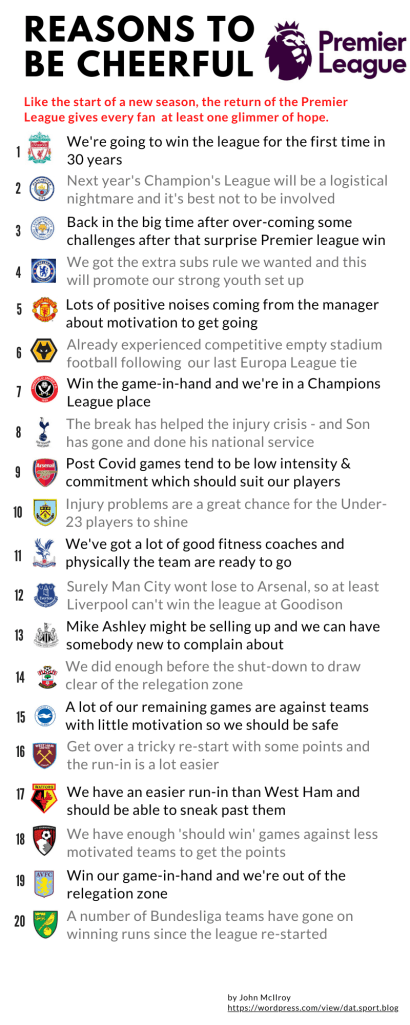
After 100 days, the restart of the Premier League feels like the start of a new season. And just like the start of the new season every fan can feel a sense of hope that this time things will be different.

Below is one reason to be cheerful for every fan. Admittedly some are better than others, and they can’t all happen as sport always has winners and losers. But sport also has hope and that is what we’re living off now (for the first fews games at least!).

An experiment in forecasting Premier League relegation (Part 1)

With the re-start of the premier League we can finally get back to action rather than talking. This also means it is time to put all these lockdowns theories to the test.

Previously I had looked at the relegation picture by comparing the fixtures of the bottom six teams. While others such as Opta have looked at historical data to assess the difficulty of the remaining games, I looked at performance this year, and perhaps more importantly, likely motivations of teams.

Originally I made some loose conclusions about what might happen but I have since put together a more mathematical model to forecast final points totals.

This is not an attempt to sell my model but rather the start of a real-time public experiment in forecasting. What I’m most interested is how the assumptions I made when creating the model play out when the action returns.

As the weeks go by I will try and refine the model and create new projections as motivations and performance levels change with results. By the end of the season I can see how this evolved and how right I was, or how wrong. In truth like a lot of things in sport it is the process rather than the outcome that is important here.

I would rather be spectacularly wrong and understand why, than brag about a successful forecast that I may not be really able to explain.

As it stands…

So before the seasons resumes this is how I see the final three, although the difference between Bournemouth and West Ham is so close it is difficult to call.

Bottom of the Premier League at the end of the season (forecast #1 16/06/2020)

PositionTeampts
15Brighton43
16Watford41
17Bourneouth39
18West Ham38
19Aston Villa36
20Norwich36

The changes in Bundesliga form since the re-start

At the time of writing this blog Bundesliga teams had played either five or six games under the new post-lockdown rules. Having a look at performance it is perhaps not surprising how teams towards the top and bottom of the table are faring better than before the lockdown.

The graph below shows the difference in points-per-game for the first 25 matches before lockdown with points-per-game since the return. While the different trajectories of mid table Hertha Berlin and Schalke standout immediately, what is most interesting is how the teams that have improved their points-per-game since the re-start are those at the top and bottom of the league.

This isn’t surprising since these are the teams with the most to play for, whether it be survival or European football. With money being tight next year, staying at the top table, either nationally or internationally, is more important than ever.

What can we expect from the Premier League re-start?

If the Premier League evolves in a similar fashion to the Bundesliga, then three things we can expect are:

  • The top teams will hold their form.
  • Mid-table teams with little to play for are not going to be trying too hard.
  • Those in the relegation battle will be harder to beat than before.

Although clubs at the bottom of the Bundesliga improved by only 0.2 to 0.4 points-per-game this still could be significant, especially as there are four clubs within two points of the last relegation place.

One other note of caution is for Southampton and Newcastle. They fit into the bottom of the ‘mid table’ group but if their points-per-game performance starts to flag dramatically, like Union Berlin or Schalke, they might find themselves drawn into a relegation battle that they no longer have the mindset for.

Currently you can get odds of 50/1 about Southampton being relegated which is the same as Manchester City winning the league. The stats suggest the former is more likely than the latter.

The week the Bundesliga reigned supreme in the UK

When BT Sport acquired the rights to show German Football in the UK they never thought they would end up with the hottest ticket in town. But for one week in May that was the case.

The graph below uses Google Trends to show the popularity of searches for “Premier League” and “Bundesliga” in the UK between the 1st March and 31st May. On the week ending 10th May the Bundesliga was a more popular search term than Premier League.

This was one week before the Bundesliga was about to restart and interest was generated by new fans seeking more information, and a period when there was a surge in searches for “how to watch the Bundesliga?”

The other interesting point is just how far searches for “Premier League” dropped once the action was suspended. The level of interest then stayed at this same level for the next two months, but in recent weeks the trend has been slowly upward.

As we get towards the resumption of the league, it will be interesting to see if this remains a steady climb, or a sudden leap once the action starts….or will it reach the pre-lockdown heights at all this season?

Given the jump in interest for a league most people rarely follow, I would expect a dramatic increase in Premier League interest in the run-up to restart.

How best to prepare a racehorse for their main target – stats show different horse racing cultures in France and England

When Victor Lodorum won the Poule d’Essai des Poulains this week, the first French Classic for colts, it reconfirmed his two-year-old form following a disappointing appearance at the start of the season. After the win connections mentioned how the horse had needed his prep run to get him ready for the main event. Comparing the results of English and French versions of this race, it begs the question, when we say ‘the horse needs a run’ is this a reflection of the horse, or the style of training.

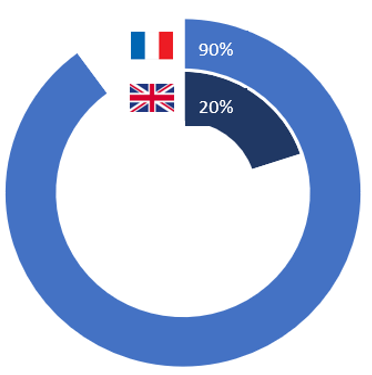
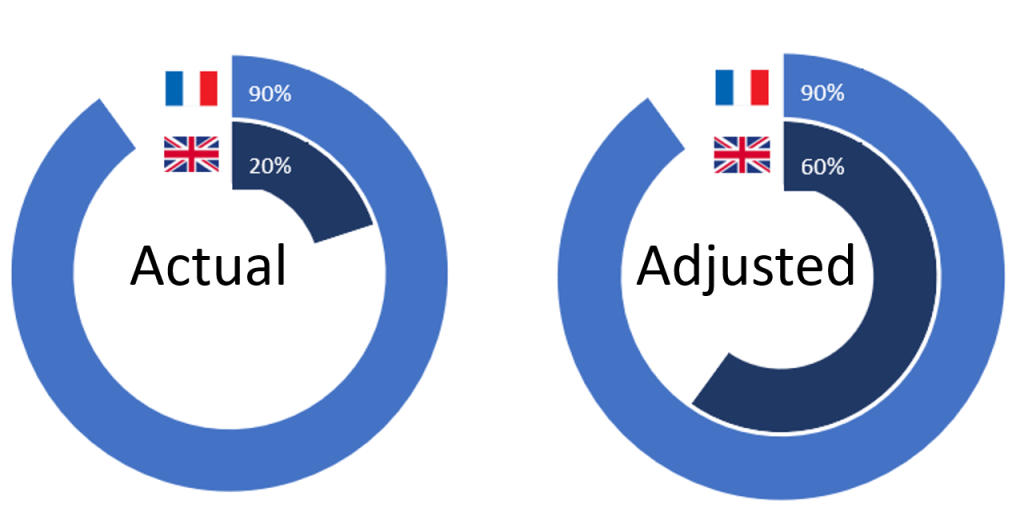
The graphic below shows the percentage of winners of the English 2,000 Guineas and French Poule de Poussi who had a prep race before winning, usually in what are considered recognised trials. In France, 90% of winners in the last ten years had a prep run, while in England the figure was 20% as trainers preferred to prepare their horses at home.

Percentage of winners who had a prep race before the Classic

While it is certainly the case that some horses will need a race as part of their development (to sharpen them up, build their fitness or get them used to being in a race), it seems highly unlikely that the best horses in France should be so mentally and physically different than their English/Irish counterparts.

It seems more probable that trainers, rather than horses, are different. At first glance it would appear French trainers are more likely to follow a tradition of running their horses in recognised trials before the classics, while English and Irish trainers tend to prepare their runners at home. However, in reality it is one trainer who has changed the face of the English Classic season.

The Aidan O’Brien Factor

Any analysis of recent 2,000 Guineas needs to consider two further factors:

  • Aidan O’Brien accounts for 50% of English 2,000 Guineas winners in the last ten years and he prefers to bring horses to the race without a run.
  • 75% of horses finishing second or third in the English 2000 Guineas in the last ten years did have a prep run.

If you were to remove horses from Aidan O’Brien (and fellow Irish Trainer Jim Bolger who O’Brien used to work for), you would end up with 60% of 2,000 Guineas winners having a prep race: closer, but still below the French figures.

Percentage of winners who had a prep run before the Classic and results when adjusted to remove Aidan O’Brien and Jim Bolger

What is the future for Classic Trials?

So the culture gap between France and England may not be as large as the bare figures suggest. But even without Aidan O’Brien there is still a gap. This shows there has already been a small shift away from the traditions of prep races in England for the 2,000 Guineas.

The results from France suggest that the pattern of prep races for the early classics is still strong. This creates a virtuous circle where prep races retain their importance as they supply Classic winners, and therefore they continue to be well supported with prizemoney.

In England the future is not so clear. If more trainers follow the route Aidan O’Brien has made so successful, then the status of the prep races will reduce (as has already started) and it will be harder to attract sponsorship. This is a more vicious circle which can already be see with the prize money for recognised English prep races around 20%-25% lower than the French equivalent.

No one can argue with Aidan O’Brien for taking the direction he does. The problem for English racing is that this success may influence the activities of other trainers as regards the early season racing programme. Keeping the best horses for the best races may open doors for lesser talented horses in early season races such as the Craven and Greenham, but if these horses are not going on to better things, then the status of the race diminishes.

Ultimately it comes down to how much you want to maintain tradition in the racing programme and how often you want to see the best horses run. I suspect that while racing authorities want to use the traditions of the Derby and Royal Ascot to attract newcomers, they spend less time thinking about how to promote early season races such as the Craven and Greenham.

The declining status of these races is a shame as they have always fitted into the development of a three-year-old across the season. This is part of the “narrative” of horse racing – a marketing phrase that promoters such as Great British Racing are keen to talk up as a way to build drama across a season.

More needs to be done to restore the status of these races as they provide the perfect starting point for the narrative. Ultimately, they need to be supported by owners and trainers, and backed up with good prize money to make it work…and this isn’t going to happen if the current trends continue.

Design a site like this with WordPress.com
Get started