What the future might hold for rugby’s partnership with Private Equity

With Rugby Australia considering a partnership with Private Equity, the total investment in the sport since 2018 is soon likely to top one billion pounds. While the investors are promising not to change the number of games being played, they are still likely to have a major influence on what fans get to see in the future.

The table below shows the confirmed and rumoured investments by Private Equity firms since 2018. Investments in leagues have typically obtained over a quarter of the league, while international rugby investments are closer to 15%. Extrapolating this into overall valuation shows the Six Nations is the most valuable asset at £2.6bn, with the New Zealand rugby brand worth £1.3bn. European leagues are much smaller, valued at £740m for the English Premiership and £430m for the Pro14.

CVC, who’s sports profile includes a successful foray into Formula 1, have been the biggest investors, but Silver Lake’s stake in New Zealand rugby will make the most headlines.

Table: Confirmed and rumoured private equity investment in rugby union

PE firmTeam/leagueValue (£m)StakeyearValuation estimate (£m)Confirmed
CVCEng Premiership20027%2018740Y
CVCPro 1412028%2020430Y
CVCSix Nations36514.3%20212,600Y
Silver lakeNZ Rugby20015%20211,300N
??Rugby Australia150*15%20211,000N
* Rugby Australia figures are from expert evaluation in press stories

Venture capitalists typically invest in a company or market that they believe is undervalued and that seems to be the reason for the interest in rugby. The initial worry would be that more value comes from more games, something that flies in the face of the growing literature on legacy injuries and concussions. However, reading the press releases of these announcements you start to see where they believe the future value lies – technology and new markets.

As the Six Nations press releases stated the partnership between CVC and the nations that control the tournament aims to:

Further enhance the sporting spectacle of all the tournaments, the teams and the brands; and to build the data, technology, and broader commercial capabilities to support these ambitious plans. These steps will ensure continued development of these prestigious tournaments for the benefit of existing fans, and to attract a new more diverse and global fan base, which will support the wider rugby community, including the players, clubs, and unions, to achieve their full potential over the long term.

Perhaps the most worrying aspect for rugby fans is the second part of the statement, creating a global fan base. While expanding the game is a good thing, it is slightly more difficult to do without adding extra games. The other solution is to play existing games in new jurisdictions, something we have already seen with the All Black playing Ireland in Chicago.

New fans in different countries will want to see the big teams and big games, and if they’re willing to pay for it, you would expect the investors to be pushing for change. For existing fans this could mean less opportunities to watch their team unless they are willing to travel.

The new investment coming into rugby is essential to cover losses from the pandemic, and it does look like a partnership that will be valuable to both investors and rugby unions and teams. However, for fans it may mean more late nights/early mornings watching games on TV rather than at the home ground.

How to maximise your TV ratings: lessons from the highs and lows of the Kentucky Derby

The Kentucky Derby is marketed as the ‘Most Exciting Two Minutes in Sports” but a 43% drop in TV ratings in 2020 must have sent shivers up the backs of organisers, sponsors and broadcasters. Thankfully, the figures for 2021 show a significant increase from 2020, and while slightly behind 2018 and 2019, they will provide some re-assurance for all involved.

The general trend for sport ratings in 2021 is towards some return to normality, but the massive dip in 2020 was about more than just Covid-19. The story of the Kentucky Derby provides some lessons that could be applied to any US sport:

  • People are creatures of habit – while there was little anyone could do prevent the Derby being run in September rather than May, the event was now out of sequence, both in terms of the overall Triple Crown narrative (Derby-Preakness-Belmont), and with casual sports fan’s lives.  If you’re a casual sports fan you know the Derby is always in May, but if it moves you might not be that much a fan to pick up when it has moved to.
  • Not everyone is there for the sport – Casual viewers often need more than just the on-field action to keep them interested. This is a big advantage for racing coverage that can also focus on the fashion and celebrities in attendance. With no crowds in 2020, there was no other story to tell.
  • Controversy can be good and bad – The higher rating for 2019 are generally attributed to the historic disqualification of the winner (the first time in the history of the race), while some of the lower ratings in 2020 are down to social justice protests around the event.

Three lessons from the Derby

  If you want to keep your TV ratings high, there are probably three things you should aim for:

  1. If you have built a tradition around a certain time of year, try to stick to it whenever possible. Your hardcore fans will follow you anywhere, but many of the rest will get lost.
  2. Not everyone is here for the sport. To maximise your ratings try to tell the stories of everyone involved.
  3. A strategy around controversy can quickly backfire. Do all you can to avoid it.

Source: SportsProMedia Kentucky Derby TV audience bounces back to 14.5m

What the Fan of the Future research didn’t understand about football fans

In September last year the European Club Association (then chaired by plotter-in-chief Andrea Agnelli) published research on the Fan of the Future. Looking at this report you can see why the ‘Dirty Dozen’ and their bankers were so sure they were on to something with a new super league of top team across Europe.

The research involved a national representative survey of 2,000 people across seven markets (UK, Spain, Germany, Poland, Netherlands, India and Brazil) and wanted to test hypotheses on fan affinity topics such as supporting more than one club, changing allegiances among younger fans, and wanting to support teams that do more than just play football.

The result was a market segmentation of football fans, and this is where the numbers must have got those executives smiling.

According the research only 25% of football fans were ‘Fanatics’ of ‘Club Loyalists’ who were emotionally attached to a specific club. The other three quarters were more interested in star players, big teams, and occasions, with the largest of any group ‘FOMO Followers’ preferring ‘European football over domestic for the perceived higher quality of entertainment that it offers.’

Time to sit back and count those Super League dollars…until everyone else heard about the plans.

So where did it all go wrong?

One thing that the research didn’t really consider was that the minority of fans who are emotionally attached to a team, provide the majority of the passion that makes everyone else want to watch. It was this passion that everyone rallied around, and football executives only needed some observational research (look out their office window) to see the results.

There was nothing wrong with the research the ECA commissioned, and it is an interesting read, but the last week has shown just how important loyal supporters are to clubs. They used to be the marketeers dream, as no matter what the quality of the product (the team) they always bought the tickets, but now you can sense a new Fan of the Future segment – the Activist.

Good luck to them.

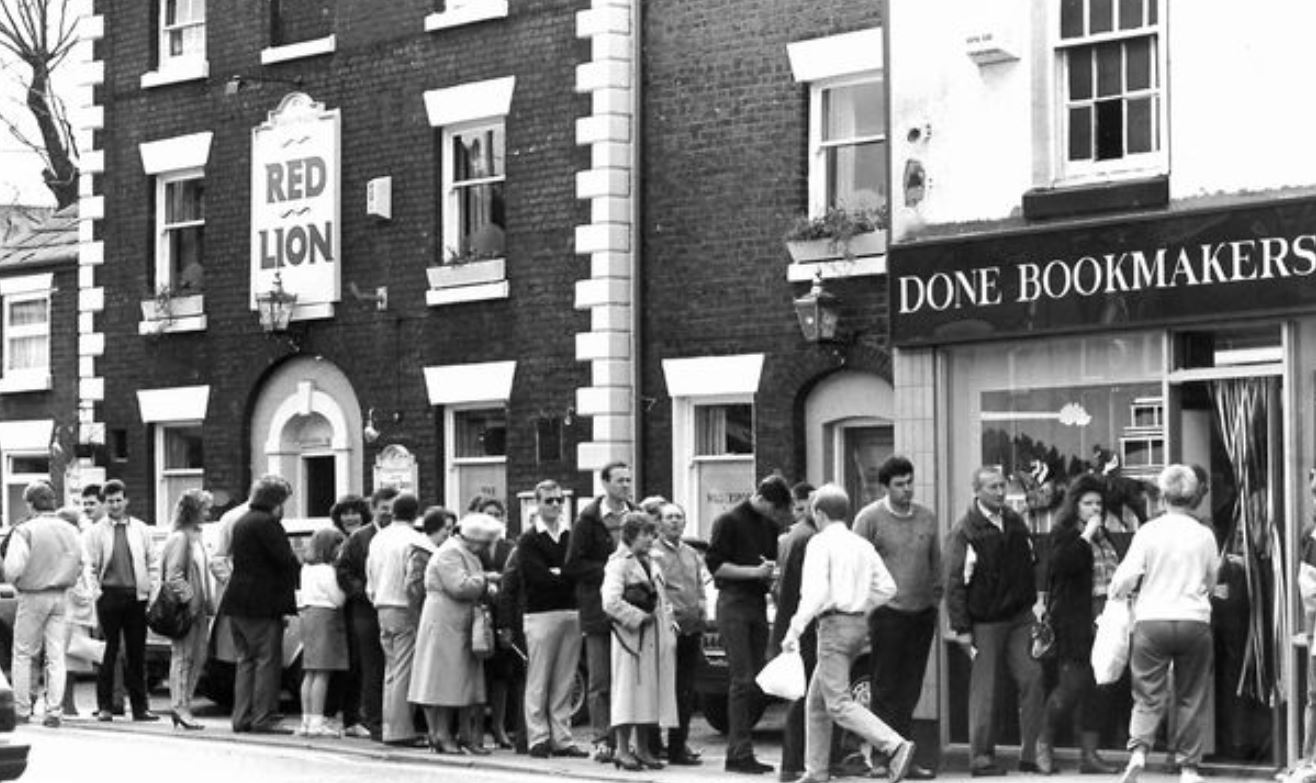
Backing the Grand National favourite isn’t what it used to be

Everybody loves a grand National favourite, especially the bookmakers. Looking back over the race since the turn of the century shows that only four favourites in the last twenty years have won the race. However, before you give up all hope it is interesting to note that a ten pound bet on the favourite each year would still have generated a £120 profit!

The interesting question is whether a similar strategy would apply for the next twenty years as there is a growing trend towards shorter priced favourites (who also tend to do less well in the race).

The graph below shows the starting price of each Grand National favourite since 2000 (the red dots represent favourites who also won). The trend line is definitely moving downwards as the average SP of the favourite in 2015-2019 was 6.4 compared to 8.8 in 2000-2004.

Even in the heyday of winning favourites, when Hedgehunter, Comply or Die and Don’t Push It all won in a six year period (2005-2010) the average SP was still 7.3.

In 2020, Cloth Cap could start as one of the shortest priced favourites in the race’s history, edging the five year favourites average ever closer to 6.

As a result the strategy of backing the favourite and returning a profit over the long term is looking more and more difficult. When prices were closer to 9 you only needed a favourite to come in once every eight years to make a profit. But now it is closer to once every five.

For a lot of people it is just the thrill of winning that matters for their once a year bet, so they will be unlikely to notice or care about the price. But it’s worth keeping an eye on how far this trend of lowering the odds continues in the future.

Data and eCommerce are driving Amazon’s sport strategy

Data and eCommerce are driving Amazon’s sport strategy

When it comes to sport Amazon is not the goose to lay the golden eggs that many people expected. Instead it has cleverly positioned itself to get what it wants from sport – more sales opportunities and a foothold in the data market.

Sports administrators used to get very excited about Amazon Prime. Here was a company with very deep pockets who would shortly move into sport broadcasting and push TV rights negotiations through the roof.

Unfortunately for the administrators, Amazon turned out to be a very different proposition. While their sports rights strategy is hard to work out, it is clear that they are selective and that their sports offering is more closely linked to eCommerce than broadcasting.

Let’s look at their selective strategy for TV rights.

  • They will pay the NFL around $1.3bn per year for exclusive rights to Thursday night football. While that sounds a lot, it is still only 13% of the total NFL TV deal.
  • Amazon shows two full game weeks of English Premier League in December, plus two other games for £30m – only 2% of the total Premier league deal.
  • They paid around £20m for the Autumn Nations Cup in rugby, which is around 40% of what BBC and ITV typically pay for the Six Nations, but it did give them 80% of all the games.
  • They will be showing 21 New Yankees games in the 2021 season, although the value is unknown.
  • Amazon signed a deal in 2020 for exclusive rights to show New Zealand cricket matches in India – the main reason being two series between New Zealand and India that will now be shown on Amazon.

What these deals have in common is buying small stakes or spending small amounts of money to secure a seat at the table of some of the biggest sport brands. The key word here is ‘small’ and this is definitely not the inflation busting activities many sports were hoping for.

So what is the strategy?

TV rights for Amazon are more closely aligned to their eCommerce offerings and Amazon Prime subscriptions.  It is telling that a few days after the NFL deal was announced a separate press release detailed how thousands of official NFL products will now be available on Amazon.

Similarly, an Autumn rugby tournament and December date for Premier League matches is well timed for the Christmas rush. This supports sales on the site and generates new or returning subscribers for Amazon Prime – the company reported 35% growth in subscribers over the fourth quarter of 2019 following its exclusive live-streaming of top-flight football.

It’s clear that Amazon didn’t behave the way many sports thought (or hoped) they might. Maybe these sports should have spent more time trying to work out how Amazon thinks. Even with Prime, it is not a traditional sports broadcaster and can afford to be more opportunistic in what it bids for. It also views any TV deals in terms of what value it will bring to customers or subscribers.

It seems likely that Amazon will continue its opportunistic approach to TV rights, picking up deals that allow it to associate with the biggest sport brands and looking for packages with a big eCommerce upside. Sports interested in attracting Amazon should consider how they can package their rights to deliver the best impact in eCommerce, for example with exclusive content or merchandise for a particular tournament.  

Data is where Amazon wants to dominate

While sport broadcasting is unlikely to see an Amazon domination, the same might not be true for data. AWS Sports is currently working with the NFL, NHL, Six Nations rugby, Bundesliga, PGA, and Formula 1. services include Internet of Things sensors for real time data, machine learning to produce the NFL’s Next Gen Stats, and high-performance computing in designing Formula 1 cars.

As more opportunities to use data in different ways emerge in sport, you would expect to see Amazon leading the field. It would be no surprise to see them picking up a few more major sport clients along the way too.

In the end it is likely to be the sports paying Amazon rather than Amazon paying the sports.  

Want to run faster? Get new shoes

A bit of personal research has shown that new running shoes can increase speeds by nearly 5%. If they do that for an ordinary runner, what must shoe technology be doing for the elite?

I have a weird habit with new clothes and shoes where I tend not to wear them if there is any danger of getting dirty. This has led me to an interesting observation about the effect of new running shoes on how fast you can run.

After getting a new pair of Asics running shoes for Christmas, I had a great January of dry conditions for running. But February has turned more unpredictable so I have sometimes been wearing my old shoes as I didn’t want to get the new ones dirty!!

This week I noticed that some of my times were different. After consistently running at the same pace for weeks, things were getting more unpredictable. So, after going back over each day I discovered the connection – the slower times were the ones when I used the old shoes.

The graph below shows my average speed with the old shoes (blue) and new shoes (pink). The average speed was 12.7km/h in the old shoes and 13.3km/h in the new ones – that’s a 4.7% increase.

Average speeds with old and new shoes

How can I be sure this was down to the shoes?

I only noticed this trend after I had done the running, so this is not an experiment with standardised conditions. However given the conditions listed below, I think it’s fair to attribute the majority of the change to the shoes. For example:

  • There were no significant differences in the weather across the days. The only reason I wore the old shoes was to avoid the puddles and mud from rain the night before. It was not raining when I ran.
  • Apart from puddles the underfoot conditions were the same (and the majority of running was on the road anyway).
  • I was running at the same time of day each time.
  • We’re in Lockdown so I only get to run the same routes and distance each time.
  • I only thought of this after I finished running so there was no unconscious bias of running faster or slower on certain occasions to make a point.  

Implications of shoe technology

I am an ordinary runner (10km in somewhere around 46 minutes) so a 5% increase in speed is interesting, but is likely to disappear over-time as the shoes wear down. But it does show how much technology can influence a sport that seems as low-tech as running.

We’ve seen this recently with a spate of new world records thanks in part to Nike’s controversial new track spikes. While World Athletics are ‘pretty calm about this’ there is always a danger that one brand will come to dominate so much that others chose to focus on a different discipline where they can get the edge.

There is a fine line between innovation and domination. One can have positive impact on the sport and the other can eventually stifle advancement. Whilst being calm, World Athletics would be wise to pay very careful attention to what is going on in the whole shoe ecosystem.  

On the pitch, NFL fans aren’t getting what they paid for

One of the most interesting things about the cost of attending an NFL game is how there is no relationship between how much you pay and how good the team is. In fact, only three of the ten most expensive NFL teams to watch had winning seasons last year. This is worse than the ten cheapest NFL teams to watch where four had a winning season.

The data for this comes from Team Marketing Report, who worked out the cost for a family of four including tickets, two beers, two sodas, four hot dogs, two souvenir hats and parking.

This demonstrates one of great rules in the economics of sport – fans are some of the best consumers a product could ever want as they will part with their money regardless of the quality of the product. 

Super Bowl value

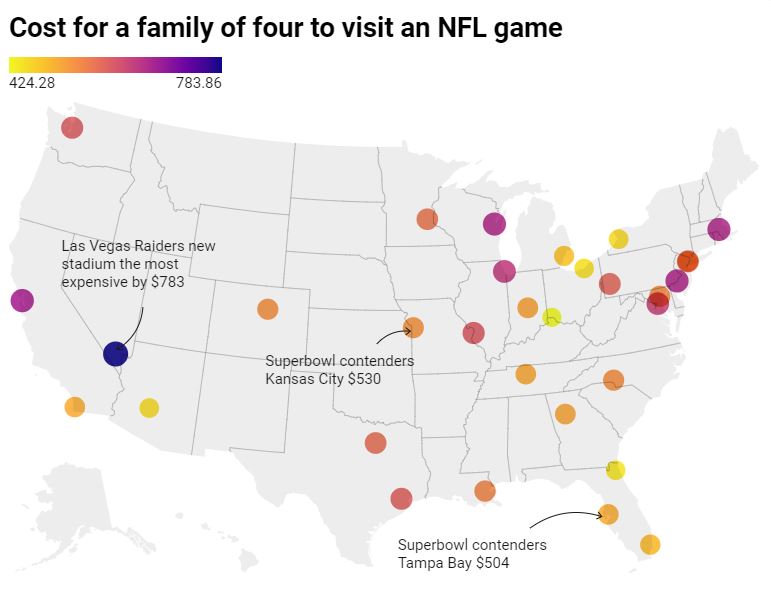
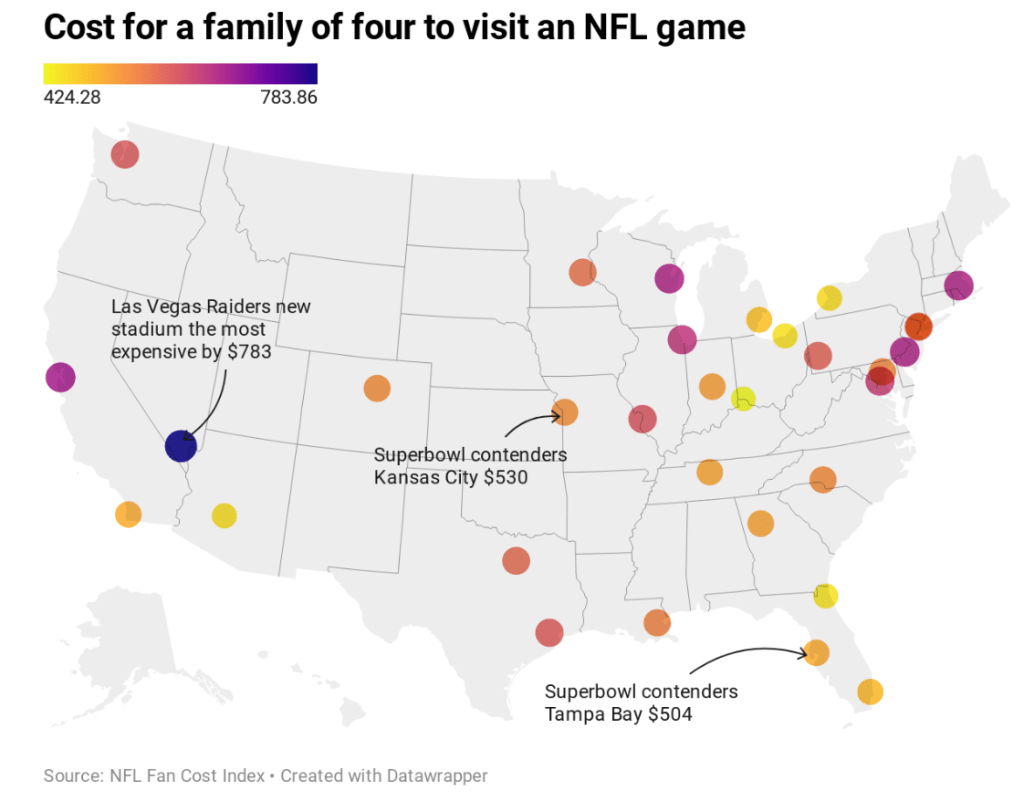
Whoever wins this weekend’s Super Bowl it is worth noting that both teams offer better value for fans. For less than the NFL average of $553 it would be possible to watch both Tampa Bay ($504) or Kansas City ($530). Compare this to the 8-8 Las Vegas Raiders where it would cost you a whopping $783 to sit in the shiny new stadium.

Where to find the value

The map below shows each NFL franchise colour coded by cost. The Southeast US is probably the best part of the country if you’re looking for value, while the North East would the worst, alongside Las Vegas and up the coast to Seattle.

In the Midwest it is more of a mixed picture, Cincinnati, Cleveland, Buffalo, and Detroit all have some of the lowest costs while Chicago and Green Bay are some of the most expensive.

There are many factors that drive the price of attending a game. The general economics of the region (large cities are always more expensive), the team history and legacy, local interest and match day experience. And of course, some fans will just pay whatever it takes to see their team.

How much empty stadiums are costing teams?

Another way to look at these figures is to think about how much revenue teams are losing while fans are not at the game (or severely reduced). Not only in terms of ticket sales, but also all the additional revenue that comes from concessions and merchandise. Estimates of total losses put it somewhere between $2bn to $4bn, so I would expect costs of those hot dogs to go up even more next year!

When time doesn’t fly – analysing the Copa Libertadores final injury time

Last night’s Copa Libertadores wasn’t much of an advertisement for Brazilian football (something I’m sure supporters of Palmeiras aren’t worrying about this morning), but what was amazing was how an injury time that saw a manger sent off and sensational last gasp winner seemed so tedious.

Going back and timing the game shows that although there were officially 8 minutes of extra time, the match lasted an additional 14 minutes. However the ball was only in play for 2 minutes 42 seconds.

This means that the ball was in play roughly for 20% of the time, which is incredibly low by any standards. Analysis of European leagues from the CIES Football Observatory suggest a typical Champions league has the ball in play for 60% of the time, while the Portuguese League had the lowest percentage (50.9%).

While some of this may be down to the heat and player tiredness, it was just one of those games that descended into absurdity, something that can happen in any league, or any local park, around the world. It was just a shame it had to be in one of the biggest games of the season.

The lowest points total in a decade is likely to win the Premier League

This year’s Premier League could be won with the lowest points haul in ten years. Is this a new trend or Covid related blip – and could we see another Leicester?

Last week my blog was like a half-time report on the English Premier League. Looking at league position and points per game after most teams had played 19 games showed who had improved since last year, who had got worse, and who had generally just stayed the same.

Another interesting point that emerged from the analysis was how many points would it take to win the league this year? If the form in the second half of the seasons matches the first half, then we are looking at around 80 points to win the league.

Looking at the table below, which shows the champion’s points tally each year since 2011, this would be a similar total to 2010/11 or Leicester’s winning season in 2015/16 (81 points).

If the winners do score around 80 points this year it would be in contrast to a recent trend of winner’s scoring closer to 100 points – indeed over the last four seasons the average points total is 97.5.

To match this average a team would need to find some form in the second half of the season (most likely Manchester City at present) and go unbeaten. So it is unlikely.

For supporters, there are two ways of looking at this lower projected winning total.

  • One is that it is a return to normal when winners usually scored in the 80’s. In recent years it has looked like Manchester City and Liverpool were going to carve up the league between them leaving everyone else in their wake. Perhaps such dominance is hard to sustain and both teams are reverting to the mean.
  • The other is that this dip in points total is the result of the unusual Covid impacted season, and indeed the second half of the last season. Normal service will return in 2021/22 and the bigger teams will power ahead.

If you’re a supporter of Liverpool or Manchester City you’re probably hoping it is the latter, and the last few seasons were not the high-point of a generation. If you support other teams you will of course hope it is the former and the best teams are coming back to the pack.

Alternatively, you could be thinking that a low winning total opens up the league to another miracle story like Leicester. You wont care about Covid regulations, if a crazy season means you win the league.

The Premier League half-time review – winners and losers

The Premier League is highly competitive and an analysis of the first half of the season shows that it moving up the league requires significant performance improvement.

This weekend marked the halfway stage of the Premier League for most clubs (although Covid postponements have not made it a perfect split). Since most teams have now played 19 games, it seems like a perfect time for a half-term report.

By comparing the league table with the same time last year we can see who has improved, who is getting worse, and who is just the same.

Of the seventeen clubs who played in the league last year, seven have improved their position, nine have slipped down the league, and one (Arsenal) has stayed in the same place. This is shown in the chart below that plots changes in position along the horizontal axis and changes in points per game along the vertical axis.

The chart also shows the significant relationship between increasing points per game and position. Basically, it is a competitive league and if you want to seriously move up the league you have to dramatically improve your performance. This is not a league where you get ahead by standing still.

Winners and Losers

The biggest winners have been Aston Villa and West Ham, who have both increased 10 places with an extra average points per game of 0.8 and 0.6 respectively.

The other group of happy supporters are to be found in Manchester and Liverpool. Although there is now a reversal of fortunes from recent years, with Man Utd sitting on top of the league (6 places better with an extra 0.6 points per game) while Everton have improved seven places with an even better 0.7 extra points per game.

As for their neighbours, Man City are pretty much the same as last year (and therefore still dangerous in second), while Liverpool have dropped three places.

For the last couple of years Liverpool have been so good that they seemed to be the outliers in every statistic. The same is true here, but this time they are outliers in going backwards. They have the second biggest drop in points per game (1.1 points per game less than last year) but have only dropped three places, whereas Sheffield United who have dropped 1.3 points per game are now 13 places worst off. The difference of course is that Liverpool where so far ahead last season its like they have now reverted to the mean.

As for the other not enjoying their season, the teams who have lost the most ground this year include Wolves (nine places), Chelsea and Newcastle (both five places), and Crystal Palace and Burnley (both four places).

Of course this is only half-time, so it will be interesting to see where they all end up at the end of the season.

Design a site like this with WordPress.com
Get started