
The recent decision by bookmakers William Hill to close more than 400 shops will reduce revenues to the sport of horse racing by an estimated £50-£60 million. The story is a cautionary tale for several football clubs about the need to plan in advance.
The rise and fall of Fixed Odds Betting Terminals
The story of reduced horse racing prize money starts with Fixed Odds Betting Terminals (FOBT). Basically, high value slot machines that became a license to print money for bookmakers. Only four terminals were allowed per shop, so the UK saw an explosion in shops openings across the country as bookmakers tried to maximise profits. By 2018 there were nearly 33,000 machines generating £1.7bn(1).
For the sport of horse racing this was a positive development. The sport is part funded through a media rights deal with bookmakers that pays £30,000 per shop - so the more shops the more money.
But problems were on the horizon. FOBTs had a reputation for ruining lives, in part due to the speed with which they could separate a problem gambler from their money, and the evidence provided to government convinced them to act and reduce the maximum stake from £100 to £2.
The decision by the government in May 2018 was the beginning of the end for the good times of easy profit for bookmakers (although reports dating from October 2017 already showed the direction this was heading). The decision to close shops was an inevitable consequence but as Guardian journalist Chris Cook points out, no one in the sport seems to have noticed or planned for the loss of revenue, preferring instead to cross their fingers and hope for the best.
The sport can now expect to see an increase in the simmering conflict between horse owners and racetracks over the amount of prize money available.
The case of football
With the FOBT problem addressed, the next target for campaigners will be online gambling. Already bookmakers have voluntarily agreed not to advertise on TV during live football broadcasts, but how long before the government starts to regulate the advertisement of online gambling more closely? With perhaps the most obvious place to start being the shirt on the players back (or more importantly logo on the players front).
Gambling shirt sponsorship is worth nearly £50 million, or 1% of Premier League clubs turnover(2). But as is so often the case in the Premier League, removing the big clubs reveals a different story. While the ‘Big 6’ are supported by financial services, airlines and car manufacturers the remaining clubs have a much more eclectic mix of sponsors.
The six clubs who are sponsored by online gambling are shown below. Along with an estimated percentage of revenue accounted for by this sponsorship. While shirt sponsorship accounts for between 2% and 6% of overall turnover it does represent a significant proportion of commercial income for some clubs. West Ham receive over 40% of commercial income from gambling sponsorship, and Bournemouth 39%.
Figure 1: percentage of commercial income and turnover from gambling sponsorship
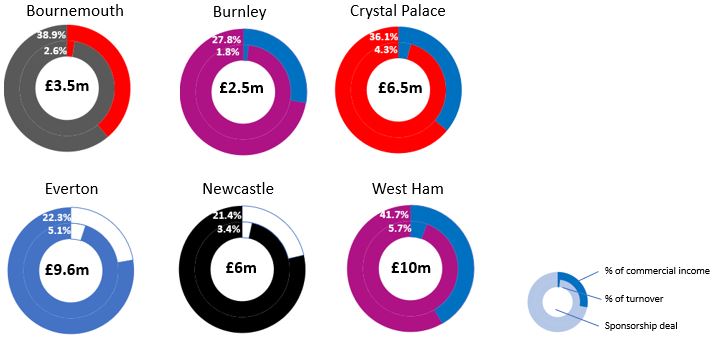
While TV revenues continue to make up the majority of turnover many of these clubs often flirt with relegation (Newcastle, West Ham and Burnley between them spent 156 days in the relegation zone last season) and a drop into the Championship will likely expose them to a greater dependence on their commercial revenue and its gambling connection.
What the future holds
It will be interesting to see how this story develops over the coming seasons. Online gambling is not a crime and it’s not going to be made illegal, but the promotion of online gambling is likely to come under greater scrutiny. With FOBTs out of the way, advertising is likely to be next on the list of campaigners’ targets.
Will these clubs follow the horse racing example and make hay while the sun shines, ignore the obvious winds of change coming from government, and then wake up one morning to the shock of reduced revenue?
If so, that’s when the scramble will start as seven clubs compete for new sponsorship revenue. Perhaps it’s time to get ahead of the competition and think about a gambling exit strategy.
Sources
(1) House of Commons Briefing Paper (2019) Fixed Odds Betting Terminals
(2) http://www.sportingintelligence.com/2018/07/30/manchester-clubs-lead-the-way-as-pl-shirt-sponsorship-climbs-to-313-6m-290701/ & http://www.theguardian.com/sport/2019/jul/05/talking-horses-everyone-a-loser-with-william-hill-closures-news
 Sport.dat